Thursday, March 20, 2008
Wrap-up
I finished the Jewish Literature Challenge today. My post with links to all reviews is here.

Wednesday, March 19, 2008
Megillat Esther
 Happy Purim!
For my next entry in the Jewish Literature Challenge series, I chose a graphic novel-style interpretation of the Megilla, the story of how Queen Esther saved the Jews from slaughter by King Achashverosh and his advisor, Haman, in ancient Persia, forming the basis for the Jewish holiday Purim, which begins tomorrow. Not your standard children's-book interpretation, this version of Esther's story is full of intrigue, conspiracies and reversals, not the least of which is the physical reversal of the text which occurs halfway through. At this point, the reader needs to flip the book over and read it right to left, all the better for the Hebrew but possibly jarring for readers unfamiliar with reading Hebrew or (in my case) Japanese manga. But I digress.
This Megillat Esther is a treasure, a beautiful and thoughtful retelling of the Book of Esther. The story is told in English and beautifully-lettered Hebrew, and includes rabbinic footnotes and a bibliography, as well as a section explaining the importance of citations and explaining the term midrash, the orally-told stories that expand on the Hebrew Bible. This section seems aimed at children, but this is no children's book. Waldman's rich, detailed black and white illustrations reward careful attention and a slow, deliberate pace, and there is some racy sexual content and innuendo that would make me hesitate to include this volume in a library collection for children, although it would be wonderful for adults who can be persuaded to read a "comic book."
Waldman's Megillat Esther is a real treat. I had a hard time tracking down a copy through my local public library system, but it's worth a read, at Purim time or anytime.
Monday, March 3, 2008
The Cage

Sender, Ruth Minsky. 1986. The Cage.
The Cage by Ruth Minsky Sender is one of the most outstanding Holocaust memoirs I've ever read. The narrative is told loosely through a framework. That is in the first chapter, Ruth Minsky Sender begins her narrative by setting it in the present day (or what would have been the present day when it was being written). She frames her story around questions her children asked about why they had no grandparents, no cousins, no extended family, etc. This, I believe, is quite effective in drawing you into the story. Of making you see the big picture.
Nancy looks at me, bewildered. "Why did they let them do it? Why didn't people stop them?"In simple but haunting prose, the narrative tells the story of one girl's survival. Riva, our narrator, is a child-soon-to-be-a-woman growing up in Lodz, Poland. Her world changes, her future changes when the Nazis invade Poland. Friends? Neighbors? Vanish overnight it seems. You see, it's not safe to be 'Polish' anymore...better to be German. To blend in with the oppressors. To take up their mantras. To join with them side by side. To pursue the destruction of the Jewish race. There is no one to stand up for the Polish Jews. (Or should I say there are few if any that are willing to make such a stand.) The story of Riva and her family--her mother, her brothers, her sisters, is powerful.
Why did they let them do it? Why did they let them do it? It echoes in my ears. Many voices ring in my ears. Voices I have heard before. They are all calling, Why? Why? Why did they let them do it?
I hear Mama's voice, filled with hope. A world full of people will not be silent. We will not perish in vain. She was so sure. But she perished, and the world was silent.
Tears fall down my face. Nancy's soft hands wipe them away. "But, Mommy, it could not happen here. Our neighbors, our friends, they would help."
Suddenly it is 1939 again. (4)
Riva finds her strength in poetry. You might could even say that poetry saves her life in more ways than one. This is her story.
Camp Mittelsteine, GermanyFirst sentence: Warm rays of sunshine fill the house, mixed with the sweet smell of lilac in full bloom.
September 23, 1944
Riva Minska, Number 55082.
When my tormented heart can't take any more
The grief within rips it apart;
My tears flow freely--they can't be restrained
I reach for my notebook--my friend.
I speak to my friend of my sorrow
I share my anger, my pain.
I speak to my friend of tomorrow
Of a future we'll build once again!
The pillars I build for the future to come,
I knock down and build once again.
I share all my dreams, share my hopes with my friend
Share the pain that is filling my heart. (178)
Last sentence: As long as there is life, there is hope.
245 pages
Such a Prince, by Daniel Bar-el

Such a Prince, a new picture book for elementary-school children by Dan Bar-el, is a lively retelling of the "three peaches folktale about a sick princess who needs three perfect peaches to get well. In return for providing the peaches, her father, the king, promises the girl's hand in marriage. This version is narrated by Libby Gaborchik, a fuss-budget little fairy who takes a liking to a skinny, feckless young man named Marvin and helps him win the princess.
The book is a joy from start to finish. The story is funny, the characters are recognizable fairy-tale types used perfectly. My favorite character is the unabashedly loud-mouthed, assertive Princess Vera, who even from her sickbed will express herself in quite the forthright manner. And the pictures! The guache and colored-pencil pictures are appealing, colorful and complement the fast-paced, rolly-poly story. Even the endpapers, depicting bunnies bouncing here and there, contribute to the overall atmosphere of hyperkinetic action.
When I first read the book silently, I enjoyed the humor and the beautiful, vibrant illustrations. But it really came to life when I read it out loud- Libby's playful, irreverent tone, only a little sarcastic at times, is a great match to the bouncy, bright pictures, and sounds great when spoken. The lively Yiddish-inspired syntax is to blame. Even without using a single Yiddish word Bar-el does a great job of capturing the uniquely expressive sound of Yiddish-inflected English and it's this trait that lends the book so beautifully to being read aloud. So read it, enjoy it, have fun with it, and read it out loud- though you might have to ham it up a little to really do it justice!
Friday, February 29, 2008
Bagels from Benny

Bagels from Benny is a very sweet picture book that tells the story of Benny, a little boy who loves to help out at his grandfather's bakery and wants to find a way to thank God for his grandfather's wonderful bagels. He hits upon the idea of leaving a bag of bagels in his synagogue's ark- where the Torah is kept- because it just seems sensible to leave a gift for God in with His book. A poor man who comes to pray finds the bagels- and believes they are from God. When Benny's grandfather finds out what Benny has been doing with his bagels, grandfather and grandson share an important lesson about the transformational power of kindness and generosity. It's a really lovely story with an important lesson, based on an ancient Jewish legend from Spain. Petricic's illustrations in watercolor and pencil are by turns funny and beautiful and echo the emotional tones well. It won the Sydney Taylor Book Award in 2003. I love Bagels from Benny!
Wednesday, February 27, 2008
Mozart Question

Morpurgo, Michael. 2008. The Mozart Question.
Don't let appearances deceive you. This book may not look like much. It's a small book after all. But it can pack a "wow" with the best of them. It's not a novel. It's not a picture book. It's definitely for older readers--upper elementary on up. What is it about? Well, even the book starts in a roundabout way.
The question I am most often asked is always easy enough to answer. Question: How did you get started as a writer? Answer: Strangely enough, by asking someone almost exactly that very same question, which I was only able to ask in the first place by receiving a dose of extraordinarily good fortune. I had better explain.The Mozart Question is a story within a story. The story is framed around that of a reporter--a new reporter hoping for her big break--interviewing a famous musician. The inside story is that of the musician. It is that story that in my opinion is able to pack quite a wow.
Lesley is a new reporter. She's only worked at the paper for a little over three weeks. But when her boss is unable to get the story--get the interview--due to a skiing accident, Lesley takes her place. Her job? To go to the home of Paolo Levi. Her instructions: Don't mess up! And above all else DO NOT ASK HIM THE MOZART QUESTION. The problem? She doesn't know what "the Mozart question" is. So she can only hope that she doesn't ask it accidentally. When she arrives, he tells her she may ask one question. Nervous she goes for it heart and soul, "I wonder if you'd mind telling me how you got started. I mean, what made you pick up a violin and play that first time?" His answer stuns her, wows her if you will.
I hope you'll read The Mozart Question yourself so you can see just how magical this short, little book really is.
Another (recent) review of The Mozart Question.
The Book Thief - Markus Zusak

Title: The Book Thief
Author: Markus Zusak
Country: Australia
Year: 2005
Pages: 552
Rating: 5 out of 5
You can find the complete review here.
What I thought: I can not come up with the words to describe this book that would do it justice. It is that good. It is written from the unique perspective of Death, a wry, frank, and compassionate character who sees moments in shades of color: The last time I saw her was red. The sky was like soup, boiling and stirring. In some places, it was burned. There were black crumbs, and pepper, streaked across the redness. (p.12). We learn how Death comes to know the book thief and her story. It is an emotionally draining read.
Towards the end, I was reading parts out loud to my daughter when she was fussy, so that I could calm her down and try to finish the book at the same time. I had to stop, I literally could not read the story out loud without crying.
There is plenty of foreshadow. I know what is going to happen. I know how it is going to end. And I still sobbed through the last few chapters. Yet, a narrative filled with death and despair, one of the overarching themes is that of hope and love. There is so much love in this story, and overflows from the pages to the reader.
And, always a favorite for bibliophiles, it is very much a story about words:
She tore a page from the book and ripped it in half.
Then a chapter.
Soon, there was nothing but scraps of words littered between her legs and all around her. The words. Why did they have to exist? Without them, there wouldn't be any of this. Without words, the Führer was nothing. There would be no limping prisoners, no need for consolation or wordly tricks to make us feel better.
What good were the words?
She said it audibly now, to the orange-lit room. "What good are the words?"(p.521)
I was particularly captured by the story within a story - the writings and illustrations of Max, the Jew hidden in the basement. His short story, The Word Shaker, could easily be a stand alone children's book. The book is marketed as young adult fiction, but is just as enjoyable and meaningful for adults.
Monday, February 25, 2008
I Will Plant You A Lilac Tree
Hillman, Laura. 2005. I Will Plant You A Lilac Tree.
"We are going to Brunnlitz, to Oskar Schindler's camp!" I recall the shouts of joy that filled the barrack at Plaszow. But the terrible place where I now stand is not that hoped-for refuge. It is Auschwitz. (1)
I Will Plant You A Lilac Tree is a memoir of one of the women saved by Oskar Schindler. Hannelore Wolff. Except for the two-page prologue, the book is a chronological account of Hannelore's life in Nazi Germany. The book opens with her attending a Jewish boarding school in Berlin. Since Hitler had come to power, it was dangerous for Jews to walk on public streets. In spite of the risk we walked along a tree-lined avenue in a suburb of Berlin, the ever-present yellow Stars of David sewn to our jackets. (3) One day she receives a letter from her mother with the news that her father has been taken by the Nazis and has died. Weeks later she receives another letter. A letter saying that her mother and two brothers will be deported to the East on May 8, 1942. In what could only be perceived as foolish-yet-brave behavior, Hannelore writes a letter to the Nazis saying that she wishes to be deported along with her family. They grant it. Now this family of four is facing the great unknown as they board a train that could lead them--probably will lead them--to their deaths.
Hannelore's story isn't always easy to read. Let's see if I can phrase this better. Those readers who aren't well-versed in Holocaust memoirs may find it difficult to read. The way the Jews are treated is despicable. It is callous. Hannelore's story is an account of some of the wrongs she faced, some of the wrongs she witnessed. But it is also a story of courage, of hope, of strength in a time of great despair. While sometimes surviving was a matter of luck--of chance--part of it had to do with will as well. Those that lost the will to live, those that gave up hope, those that gave in to despair... Starvation. Disease. Nazis. The Nazis were responsible either directly or indirectly for so many deaths. Hannelore's story of how she survived the various camps and came to be one of the lucky few saved by Schindler is amazing and fascinating and in places quite heartbreaking.
But this memoir isn't just a testament of survival, and it isn't just an account of the wrongs against the Jewish people. It is a love story as well, a story of how love can be found even in the darkest places, the most despairing times. A story of how one young man and one young woman found hope and love in each other. A story of how that love helped them endure.
I definitely recommend this one.
243 pages.
Saturday, February 23, 2008
Night by Elie Wiesel
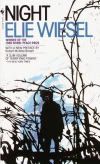 Review of Book: Night
Author: Elie Wiesel
Visit Page
Buy the Book
In Nobel laureate Elie Wiesel's memoir Night, a scholarly, pious teenager is wracked with guilt at having survived the horror of the Holocaust and the genocidal campaign that consumed his family. His memories of the nightmare world of the death camps present him with an intolerable question: how can the God he once so fervently believed in have allowed these monstrous events to occur? There are no easy answers in this harrowing book, which probes life's essential riddles with the lucid anguish only great literature achieves. It marks the crucial first step in Wiesel's lifelong project to bear witness for those who died.
***
This book gave me chills. All I can say about it is... Wow. I recommend this book to anyone and everyone. It depicts the world that we are, again, about to enter. Since there aren't enough words to accurately define how I felt about this book, I'll let past reviews speak of Night for me.
This book deserves a ten. If I could, I'd offer it an infinity.
***
What Others Said About the Book
"...a slim volume of terrifying power [and] a remarkable closeup of one boy's tragedy..." - Gertrude Samuels, The New York Times Book Review
"...There is a unique quality in the experiences of a child in hell... His book deserves to be read by everyone who is deeply concerned about the future of civilization." - Saturday Review
"There is no superfluous flesh on this gaunt and powerful narrative... It is a profound spiritual document, an affirmation by negation." - The New York Herald Tribune Books
"A striking narrative... read it if you dare." - Jubilee: a magazine of the Church
"Wiesel reminds us of the spiritual suffering and sacrifice no man can measure... but to the believer, to the Christian, he penetrates with special force." - James Finn, Commonweal
To view my list, Click here.
Tuesday, February 19, 2008
The Entertainer and the Dybbuk

The Entertainer and the Dybbuk by Sid Fleischman won the 2008 Sydney Taylor Book Award in the category of books for older readers. Fleischman won the Newbery in 1987 for The Whipping Boy. Set in the late 1940s, The Entertainer and the Dybbuk is the story of an American ventriloquist, the Great Freddie, who while on his tour of Europe becomes haunted or possessed by the spirit of a Jewish child slain in the Holocaust. This boy, Avrom Amos Poliakov, now a dybbuk or spirit, has unfinished business and he needs this former American soldier's help to be at peace. Now inhabited by this friendly, often sarcastic, mournful soul, his act has become better than ever. The dybbuk is winning the hearts of the crowds. The crowds of course don't realize that this isn't all an act put on by The Great Freddie. He's gone almost overnight from a mediocre-at-best performer to a real crowd-drawing attraction. But being possessed isn't all fun, the dybbuk means business. And he'll stop at nothing to accomplish his goals.
The book is very good, and I definitely recommend it.
Monday, February 18, 2008
Something From Nothing by Phoebe Giilman

Stars: ****
Basic storyline is a child who has a well-loved blue blankie. It gets so worn out that the mom says it has to go but Grandpa makes it into a coat. Then it wears out and mom says it has to go and Grandpa saves it once again by making it into a vest. This continues all the way to a button.
Although I’ve seen this idea before (can't find the name of the book. This one was read and I think a bathrobe first,) this one is nicely written with beautiful illustrations. Also if you look closely, at the bottom of the page mice are shown in the space below the house and they are using the scraps cut off the blankie/coat/vest etc… to make their own clothes. By the end of the book. All the mice are clothed in blue.
Although I’ve seen this idea before (can't find the name of the book. This one was read and I think a bathrobe first,) this one is nicely written with beautiful illustrations. Also if you look closely, at the bottom of the page mice are shown in the space below the house and they are using the scraps cut off the blankie/coat/vest etc… to make their own clothes. By the end of the book. All the mice are clothed in blue.
One thing that makes this book better than any others I’ve seen with this idea is the ending. I don’t like writing spoilers, even for picture books, so I won’t tell you exactly what happens but it’s a good ending.
Saturday, February 9, 2008
The Castle on Hester Street - Linda Heller
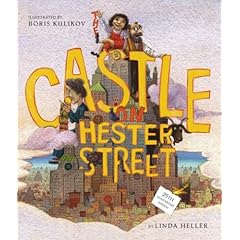 Title: The Castle on Hester Street
Author: Linda Heller (illustrated by Boris Kulikov)
Country: America
Year: 1982
Rating: 5 of 5
First sentence: One day while Julie was visiting her grandparents, her grandfather said, "Did I ever tell you about my good friend Moishe?"
This a cute story about a grandfather's tall tales of the family's immigration from Russia to America. By countering grandpa's stories of castles and moons made of matzoh, with grandma's explanations of how things really were, Linda Heller has created a gem of a book in teaching kids about the experience of immigration. It's an endearing story that all ages could enjoy.
Subscribe to:
Posts (Atom)