Showing posts with label Becky. Show all posts

Thursday, April 23, 2009

Emil and Karl


Glatshteyn, Yankev. 2006. Emil and Karl. Square Fish. (Roaring Book Press) 194 pages.

There is an immediacy and urgency to Emil and Karl. Written in 1938--in Yiddish--it was only recently (2006) translated and published in English. Set in Austria, Vienna to be exact. The Third Reich is in power, yet the horror of World War II has not yet dawned. The full wrath unleashed during the Holocaust--the organized full-scale murdering of the Jewish people*--has yet to begin. Though the hate is strong and ever-present. Meet Emil and Karl. Best friends. One is Jewish. The other is not. But despite it being in Karl's "best interest" to forget about his Jewish friend, Emil, he can't brush him off.

The seriousness of the novel is apparent from the very beginning. When we first meet Karl, he is alone.

"Karl sat on a low stool, petrified. The apartment was as still as death. He looked at the pieces of the broken vase scattered on the floor. Several times he reached out with one hand to pick up an overturned chair lying beside him. The chair looked like a man who had fallen on his face and couldn't get up. But each time Karl tried, he could only lift the chair up a little bit, and then it fell down again. It was even quieter in the kitchen and the bedroom--so quiet he was afraid to go in there. It wasn't that Karl minded being in the apartment by himself. He'd been left alone there more than once before; he could even go to bed by himself without being afraid. He wasn't scared of spooks or devils. Instead, he loved to stare, wide-eyed, into the darkness and make up stories." (1)


Why is he afraid? He witnessed what I imagine would have seemed the unthinkable. He watched them take his mother. He watched them hurt her. He heard their threats. He heard them threaten to come back...for him. In one night, everything in Karl's world is turned upside down.

When he does move, act, it is to go see his friend, Emil. He seeks the comfort of a true friend. What he learns is that Emil too has changed. Emil and Karl have an enemy in common now. Both have been orphaned. Both have only each other. Can these two children find a way to survive in this topsy-turvy ever-dangerous world where hate rules supreme?

What makes Emil and Karl unique--in my opinion--is its urgency. When it was written, this wasn't a distant event in the past. This wasn't historical fiction. This was current events. This was the threat and danger facing the world. And at the time it was written, it was a threat that had not been conquered. There's a suspenseful quality to it. A sense of the unknown. There was no happy ending light at the end of the tunnel to brighten it up. In fact, the worse was yet to come. It's an emotional novel; it's brilliantly and intelligently written to make you feel that you are there, that you are witness.

Thursday, March 26, 2009

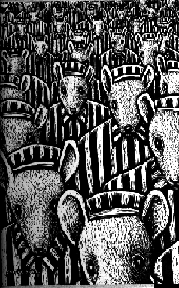
Maus by Art Spiegelman


Spiegelman, Art. 1986. Maus I: A Survivor's Tale: My Father Bleeds History.

This is a true-must-read of a book, well, a graphic novel to be exact. But still, must-read at all accounts. I loved the format of this one. No, not just the graphicness of it. But the framework of the story. How this novel is just as much about a father-son relationship--in all its complications--as it is about Jewishness, about the Holocaust. I also love the exploration of the psychology of it. So often with "Holocaust" books the issue of long-term effects, of psychological and emotional trauma that persists through the decades following such a horrific event, doesn't come up. It's a non-issue. Often memoirs are about a specific period of time. Liberation comes from either the Americans and the Russians. And voila. Horror over. But life isn't that easy.

In this first volume, we meet Artie, an artist, and his father, Vladek, a Holocaust survivor who is grumbling his way through a second marriage to a fellow-survivor, Mala. (Artie's mother, Anja, committed suicide in the late 1960s.) Artie seeks out his father in this volume wanting to hear his story, his past. Seeking answers to questions not only about his father, but his mother as well. Questions about the Nazis, the war, the Holocaust, how these two survived despite the odds. We, as readers, follow two stories, the contemporary setting where a son is asking some hard questions of his father and getting inspired to write about them in graphic novel form, and the historical setting--1930s and 1940s--where we meet his parents and learn their stories and backgrounds.

His father isn't in the best of health, and their relationship is strained. The book addresses the question of if parents ever really understand their children and/or if children can ever truly understand their parents. Can stressful tensions--ongoing issues and conflicts--ever be resolved peacefully? The drama is just as much about healing as it is the Nazis. And I think that is one of the reasons it's so powerful, so resonating. These characters--represented as mice in the novel--feel authentic. They're flawed but lovable. Their stories matter. (By the way, the Nazis are cats. The Polish are pigs. The French are frogs.)

The story is continued in Maus II.


Spiegelman, Art. 1991. Maus II: A Survivor's Tale: And Here My Troubles Began.

If Maus I was great, Maus II is even greater. If you thought the first one was heart-felt and moving, wait until you get to this one. Everything is more intense. The sorrows and griefs are even deeper; the actions even more troubling. For here we get to the heart of the story. The darkest place of all. Artie's father and mother have been captured by the Nazis and sent to a concentration camp. (In this graphic novel, the name is "Mauschwitz" instead of Auschwitz.) In the contemporary story line, we see that Artie's father isn't doing well; in fact, it becomes obvious, that he's dying. This complicates things tenfold. More guilt. More anger. More frustration. Even in fine health, Artie had a difficult time getting along with his father. Now, when his father perhaps needs him more than ever, he's crankier and grouchier and meaner than ever. Life isn't easy. Never easy. This is a complex novel--graphic novel--with heart and soul. Highly recommended.

Friday, February 13, 2009

Tropical Secrets


Engle, Margarita. 2009. (March 31, 2009 Pub.) TROPICAL SECRETS: HOLOCAUST REFUGEES IN CUBA. Henry Holt. 198 pages.

Read. This. Book. True, it won't be released for a few more weeks. But make note of it now to get to this one when you get the chance. Written by Margarita Engle--an acclaimed verse novelist--the book is the story of Daniel, a Jewish refugee, and the friends he makes in Cuba--Paloma and David. Daniel had no intentions of going to Cuba. When his parents tearfully sent him away--hoping and praying that at least their son may survive--this was right after the Night of Crystal or Broken Glass; they all thought that his ship would reach American shores--having heard stories of Lady Liberty and America being the place where all were welcome and the land where dreams could come true. But Daniel's ship was turned away from both Canada and the United States. His one chance for survival now depends on Cuba's mercy. The year is 1939. Does Daniel have a prayer of a chance?
This verse novel is told primarily in three voices: Daniel, Paloma, and David. Paloma is the daughter of "El Gordo" a man who is hoping that these refugees will make his wallet fat--very fat. The bigger the bribe, the higher the cost for a visa to enter the country, the richer he becomes. And with the Nazis even sending men to spread propaganda about Jews, the public isn't necessarily on their side--open to the idea of Jews being allowed to enter and settle there. Still, Daniel's ship is allowed. But we're not talking about one ship or even a dozen ships. David is a Jew--a Russian Jew who fled Russia many years before. Paloma helps David--and others--help the refugees providing food and clothing and friendship and support--teaching them Spanish, for example. The book is a novel about meaning things: hope, life, survival, friendship, tolerance. But it doesn't hide the fact that this was a very ugly, very brutal, very cruel time in history.

I don't know about you, but I'd certainly never heard about Cuba in regards to the Holocaust. It's interesting to see how this one island, small in size especially when comparing it to Canada and the United States, was able to provide some shelter to Jews fleeing Hitler. In the author's note she shares, "Despite tragedies and scandals, Cuba accepted 65,000 Jewish refugees from 1938 to 1939, the same number that was taken in by the much larger United States during the same time period. Overall, Cuba accepted more Jewish refugees than any other Latin American nation."

This book is fascinating. It's absorbing. Read. This. Book.

Wednesday, January 7, 2009

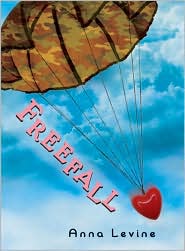
Freefall


Levine, Anna. 2008. Freefall.

I am about to jump. I am about to jump wearing a full load on my back. Feet, knees, hip, back, roll. Crammed tightly, the pack is stuffed with my anxieties, fears--and army-issued parachute. It is secured to my chest with strings and clasps. It hold my heart in place, should it try to break free. When the time is right, I will yank the cord. At that moment, the pack will open. My fears will rise to the dome of my chute, where they will hover. And for a moment I will be free of them. Feet, knees, hip, back, roll.

I loved the opening of Freefall. It was a nice introduction to our heroine, Aggie, and her situation--she's an Israeli woman embarking on a new phase in her life: serving her country as a paratrooper. The book is set in Israel. And it features Aggie and her friends and family. Every person--man or woman--is required to serve their country for several years. It doesn't mean that all people see active combat duty, but for some it does. Aggie's family wants her to be assigned a desk job; a job where she'll be as safe as anyone can be in these dangerous days where terrorists can wreak havoc on ordinary citizens in their homes, schools, and workplaces. But Aggie...Aggie is considering joining an elite paratrooper troop (or are they called squads?). Regardless of the term, Aggie is considering active duty, something that will challenge her physically, mentally, and emotionally. The book is about more than army training--far from it--it's about life: friendship, family, and love. Aggie is falling for the brother of one of her best friends. And he just happens to be a solider.

What I enjoyed about Freefall is that it gives a new perspective. I don't know about you, but I don't come across many books set in Israel narrated by female soldiers, books that provide a unique take on what it is like to live in a country where the threat of terrorists or war (some threat or another) is always lurking. While there are elements that will more exotic to readers, there are many elements that will feel familiar--her thoughts, feelings, and concerns about friendship and love and life.

I liked Aggie, and you may like her too.

Tuesday, January 6, 2009

As Good As Anybody


Michelson, Richard. 2008. As Good As Anybody. Illustrated by Raul Colón. Knopf.

I received this one just yesterday, but as soon as I saw who illustrated it, it jumped to the top of my priority list. Raul Colón has received both Gold and Silver Medals from the Society of Illustrators. And his work is incredible. Incredible. Just beautiful, wonderful, oh-so-amazing work. The kind of illustrations that you are just in awe of really. As Good As Anybody is the story of two men: Martin Luther King, Jr., and Rabbi Abraham Joshua Heschel. Two men. Two stories. Both powerful. The first person the reader is introduced to is Martin Luther King, Jr. And chances are that this won't be anyone's first introduction to the legendary man. The second person readers meet is Rabbi Abraham Joshua Heschel, a Jewish man that became active in the Civil Rights movement. Chances are good that this will be the first introduction to this man. It's also the story of how two men from two different backgrounds came together in the mid-sixties for a worthy cause. The text by Richard Michelson is simple and straight forward. It tends to be more concise than verbose. (Which isn't a bad thing for a text to be at all. In fact, you could say it was a very good thing.)

Definitely recommended.

Monday, January 5, 2009

Memories of Babi


Siegal, Aranka. 2008. Memories of Babi.

A collection of nine short stories--loosely connected much in the same way as A Long Way From Chicago works--about a young girl spending time with her grandmother. Set in pre-World War II Ukraine (near the Ukraine/Hungary border really), the stories feature a Jewish family living side by side with their gentile neighbors in this small mountain community. The stories are fictional but based on the author's childhood memories of her time with her grandmother. The stories have little life lessons packed into them, but not in a preachy way.

I read this book about a month ago. So the details are sketchy when it comes to individual stories. But I do remember liking the book in a general way.

The author is Aranka Siegal who won a Newbery Honor for her autobiography Upon the Head of The Goat in 1982.

Tuesday, December 30, 2008

In My Hands


Opdyke, Irene Gut. 1999. In My Hands: Memories of a Holocaust Rescuer.

I did not ask myself, Should I do this? But, How will I do this? Every step of my childhood had brought me to this crossroad; I must take the right path, or I would no longer be myself. You must understand that I did not become a resistance fighter, a smuggler of Jews, a defier of the SS and the Nazis, all at once. One's first steps are always small: I had begun by hiding food under a fence. Now I was making plans to... (142-143)

In My Hands is nonfiction--a memoir--and it's a powerful one. Full of descriptive images you might wish you'd never seen. But it's an important work, a necessary one. Our narrator, Irene Gut, was a Polish girl--a young woman training to be a nurse when the war burst into her life. The conflict between Germany and Russia stripping her of her childhood in more ways than one. Her account of what happened during the war years are powerful and haunting. But there is nothing over-the-top either. It's straightforward, spare, even.

This is her description of the purging of the Poland of Jews (I believe we're speaking of the ghettos.)
The gates were dragged open, and the Jewish prisoners were forced out through a gauntlet, while the guards beat at them with their rifle butts. An old man, tottering with a cane, was not fast enough, and a guard shot him on the spot. In vain, women tried to protect their small children from blows, men tried to shield their old fathers. But every time someone stumbled and fell under the beatings, shots rang out. The street was paved with bodies, and still the Jews were forced to march out over them.
We watched this from our windows in a paralysis of horror. We could do nothing but watch. We could not even pull back from the glass to keep hidden. An old rabbi carrying the Torah stopped to help a young woman with a shrieking toddler, and all three were shot. A graybeard in a faded uniform of the Polish army from the last war limped past the guards, and he, too, was not fast enough. The sun shone down on all of them, and the dust settled in pools of blood.
By this time, the four of us were crying uncontrollably. Helen was on her knees, sobbing in her mother's arms. Janina turned her face away. But I watched, flattening myself against the window. As I pressed against the glass, I saw an officer make a flinging movement with his arm, and something rose up into the sky like a fat bird. With his other hand he aimed his pistol, and the bird plummeted to the ground beside its screaming mother, and the officer shot the mother, too. But it was not a bird. It was not a bird. It was not a bird.
(116-117)

This is how she sums it up, "We did not speak of what we had seen. At the time, to speak of it seemed worse than sacrilege: We had witnessed a thing so terrible that it acquired a dreadful holiness. It was a miracle of evil. It was not possible to say with words what we had witnessed, and so we kept it safely guarded until the time we could bring it out, and show it to others, and say, "Behold. This is the worst thing man can do."" (118)

© Becky Laney of Becky's Book Reviews

Tuesday, December 23, 2008

Hanukkah by Roni Schotter


Schotter, Roni. 1990. (Rereleased in October 2008). Hanukkah! Illustrated by Marylin Hafner.

This is a simple but joyful introduction to Hanukkah. It begins simply,

"In darkest December
Night steals in early
And whisks away the light.

But warm inside,
Mama, Papa, and Grandma Rose
Light the sun that is the menorah.

While Nora and Dan,
Ruthie and Sam
Sing a song that is a prayer."

That will give you some hint what the text is like. This one has won the National Jewish Book Award. Definitely recommended.

Thursday, April 24, 2008

Becky's Completed List


Callista is hosting a new challenge, the Jewish Literature Challenge. It does have its own blog. I'm assuming she'll invite participants so they can post their as well as on their own blogs.


Golden Dreydl by Ellen Kushner
The Book Thief by Markus Zusak
All of a Kind Family by Sydney Taylor
The Entertainer and the Dybbuk by Sid Fleischman
I Will Plant You a Lilac Tree by Laura Hillman
The Mozart Question by Michael Morpurgo
The Cage by Ruth Minsky Sender
Diary of A Young Girl by Anne Frank
I Have Lived A Thousand Years by Livia Bitton-Jackson
My Bridges of Hope by Livia Bitton-Jackson

Wednesday, April 23, 2008

My Bridges of Hope


Bitton-Jackson, Livia. 1999. My Bridges of Hope.

My Bridges of Hope is the sequel to I Have Lived A Thousand Years. It is the middle book in a trilogy of the author's memoirs. (Though each book can and does stand alone just fine.) The book opens with Elli Friedmann and her mother and brother returning to their home town of Samorin after they were liberated by the Russian soldiers. Unlike some of the other returning Jews, they did find their home relatively intact. Stripped of furniture, yes, but still standing. The neighbors are shocked, extremely shocked to see them again. Shocked that they're living skeletons. But most of their closest neighbors are helpful. They give what they can, do what they can to make the Friedmann's home habitable again. This doesn't mean that every neighbor is this nice. And it doesn't mean that the family's possessions are returned from the neighbors who took them for safekeeping at the beginning of the war. But a few are ethical enough to return and restore.

"Out of Samorin's more than five hundred Jewis citizens, only thirty-six returned, mostly young men and women. Those who did not--our children, parents, grandparents, siblings, husbands, wives, aunts, uncles, cousins, friends, and lovers--have been replaced by an abyss." (18)

Imagine that if you will. Really think about it. My Bridges of Hope tells the stories of those in between years. Those years between 1945 and 1951 when Elli was growing up in such a strange and foreign environment. It looked a bit like her old home, her old town. But so many people missing, so many new people in their place, so many strangers--the Russians, the Communists coming to town and taking over. Nothing is ever the same, nothing could ever be the same.

In these years, Elli dreams of going to Israel. At the beginning of the book, it isn't even a state or nation yet. But the dreams, the Zionist dreams, are there both in Elli and in her friends. But it is decided that America will be their destination, if they can get in.

These are years of waiting and years of growing. A turbulent time of changing for Elli as she matures from a fourteen year old girl into a young woman of nineteen or twenty. The book records her hopes, her dreams, her loves, her losses, her disappointments.

Thursday, April 17, 2008

I Have Lived A Thousand Years by Livia Bitton-Jackson


Bitton-Jackson, Livia. 1997. I Have Lived A Thousand Years.

I Have Lived A Thousand Years: Growing Up in the Holocaust is the memoir of Elli L. Friedmann. Born in Czechoslovakia, Elli along with her family were taken to Auschwitz when the ghettos were liquidated in 1944. The book covers the years 1944-1945, although it hints at what came before and what comes after. The book concludes with Elli and her remaining family members arriving in America in 1951.

Her prose is concise and powerful. As a child, she loved to write poems. And this is evident in her memoir. The imagery is strong; there is power in her words. The emotions resonate. When our story opens she is around the age of 13. Here is her description of when the Nazis came and her school was closed, "I weep and weep. I weep for my classroom, which is no longer my classroom. For the school that will never be my school again. I weep for my life, which will never be the same." A bit further on we read her description of what it was like to be shown where the family's treasure was buried. The unspoken words being that she may be the only one to survive. "I don't want to know the spot! I don't want to be the one to survive! I don't want to survive alone! Alone, I don't want to live. Oh God, I don't want to live if you don't! I don't want to know about anything! I don't want to know!"

Her descriptions are so powerful, so real. The way they are written, so straight-forward, so concise, instantly put me in her shoes. The people aren't just numbers, aren't just statistics, aren't just nameless, faceless strangers. They're real; they matter; their stories, their lives count.

This was a very powerful book for me. Elli's determination to survive, to ensure her mother's survival is so courageous, so incredible. The fact that hope and strength and courage and dignity can survive in the midst of such horror is amazing to me. Wonderfully amazing to me.

This book is definitely a must read.

The title of the book comes from the liberation scene. Elli and her brother and mother are all together. They are trying to survive until they can be liberated. Freedom is within their grasp, yet there is still danger and fear on the prowl. When they are liberated, Elli is taken for an old woman. They think she is a woman who is in her sixties, they're flabbergasted to learn that she is just fourteen years old. She says, "I am fourteen years old, and I have lived a thousand years." What great imagery.

Saturday, April 5, 2008

Always Remember Me


Russo, Marisabina. Always Remember Me.

It is hard to find books--particularly picture books--about the Holocaust and World War II that are appropriate for young audiences. ALWAYS REMEMBER ME: HOW ONE FAMILY SURVIVED WORLD WAR II is a great find indeed!

ALWAYS REMEMBER ME is a story within a story. Oma is sharing her family history with her young granddaughter, Rachel, as the two look through two photo albums. One photo album contains pictures of her life in Poland and Germany. These photos contain pictures that evoke happy memories of the grandmother's life (her childhood, her marriage, her motherhood)...but some of the later pictures in the book evoke sad memories of what happened when the Nazis took control of Germany. Fortunately, Oma and two of her daughters survive concentration camp (her oldest daughter had immigrated to America). The second photo album contains pictures of the family once they have moved to America to start their new lives.

The endpapers are designed as a scrapbook/photo album. Black and white photos (also sepia-toned photos) line the endpapers with white cursive captions identifying the people, places, and ages of the photographic subjects.

There is a five word glossary identifying Yiddish and German words used in the picture book, and there is a two-page afterward summarizing briefly Hitler's rise to power and the Holocaust.

In addition to being a great story/introduction to the Holocaust, I enjoy the celebration of family that ALWAYS REMEMBER ME embodies. It is a great story about how important it is to pass down family stories and keepsakes. I love the bond between Rachel and her grandmother.

The Diary of A Young Girl


Frank, Anne. 1952. The Diary of A Young Girl.

"You're reading that again?" That's what my mother said as she caught me reading Anne Frank. Like I haven't read anything but this one book in all these years. She's right. I have read Anne Frank's Diary of A Young Girl before. But some things are worth repeating. Diary of A Young Girl is one of them. The first time I read this book, I would have been in high school. Close enough to Anne's age to feel it--the drama of adolescence on top of extreme political and social upheaval. The Diary of A Young Girl captures both. The war. The threat of death. The threat of captivity. The threat of starvation and disease. But it also captures youth. What it means to be young, to be at that ever-awkward stage in life, in development. Always a me-in-the-making, never quite done finding out who you are and what you believe and what you want out of life. Anne could be any girl in any place and time. But because she was born a Jew. Because Hitler came to power. Her life--her perfectly ordinary life--was cut short.

The book begins in June of 1942. The last entry is in August of 1944. In these two years, these two turbulent years, Anne and her family and several other people as well all go into hiding in the Secret Annexe. Mr. and Mrs. Frank. Margot, the older sister. Mr. and Mrs. Van Daan. Their son Peter. And Mr. Dussel. Eight people. Cramped living conditions. This isn't reality tv. This is life and death. Yes, every person gets super-cranky and super-sensitive. But wouldn't you?

The reader gets a glimpse into the lives of real people through the eyes of one very young sometimes-mature, sometimes-immature girl. Anne Frank. Very famous now because of her diary. But just then--at the moment--one very ordinary girl with a natural desire to write a diary. I think most kids (or teens) at one time or another try their hand at keeping journals. Though perhaps now, blogging has replaced all that. Diaries are intimate, personal, private. Each entry is a snapshot into that one day, that one hour, that one moment. When you're young, (and even when you're older and supposedly all grown up) your mood, your outlook changes moment by moment, day by day. Happy one minute, miserable the next. Such is the case with Anne. Personally, I'm surprised that Anne had as many happy moments, contented moments, grateful moment in the Annexe as she did. I think it would only be natural to be unhappy, scared, miserable, depressed. Living in cramped quarters with people you dislike, people you disagree with, not being able to go outside, to go anywhere you want. Not having the freedom to move, to make noise when you want. To always be on alert. To always worry about the threat of discovery, the threat of capture, the threat of bombs blowing you to bits. High stress. Very high stress.

But this isn't just a book about war, about being Jewish, about being a victim. This book is so much more than that. It's a book about growing up. A book about changing from a girl into a young woman with hopes and dreams and fears and desires. It's a book about being that age. That extremely awkward stage of life. My mom thought all people of that age should be shipped off to junior high island until they grew out of it. That moody, I-hate-you, you-don't-understand-me stage. Anne was a work-in-progress. There's no doubt about it. When we first meet her, she's entering that phase of life. She doesn't get along with her mother. At all. She feels completely disconnected from her. Misunderstood. Unloved. Unwanted. Unappreciated. And her relationship with her father is better, but not perfect. Sometimes she feels the disconnect with him too. And her sister. She feels that her parents love her sister more. That her sister gets all the praise, the love, the positive attention. And she feels that she gets attacked, bombarded with negative attention--lectures, lectures, more lectures. Everyone is always out-to-get-her. But though this does seem to be Anne's story, Anne's predicament, by the second half of the book, Anne is growing, changing, maturing. She looks back over past entries and realizes that things are different, things have changed. And she realizes that most of the changes were in her. She is beginning to build, to establish a better relationship with her family. She is beginning to get comfortable in her own skin.

Anne is someone I think we all can relate to in a way. Anne was just a girl. A girl with interests and hobbies. Likes and dislikes. She could be anybody.

The Diary of A Young Girl was originally published in Holland in 1947. It was soon translated into other languages, including English, and printed in the United States. 1952 is the first publication date for the United States. Almost from the very beginning, it was recognized as a good book, a powerful book, a book worthy of time and attention and respect. But it's not without its enemies.

Though I'll never in a million years understand the mindset of those that challenge books, I'll never ever ever understand why Diary of A Young Girl is one of their targets. I just don't understand it. Can't understand it. One challenge brought against the book stated that it was pornographic. How??? Why??? Fortunately, the challenge failed, and the book stayed on the shelves. I suppose pornography is subjective. But a young girl writing about her period is so not pornographic! A young girl writing about her breasts developing? Not pornographic. A young girl writing about her first kiss? Not pornographic. There is no talk, no hint of sex in the book. Though Anne spends the last part of the book making out with Peter, the son of the Van Daans. But it's not pornographic in the slightest. Not unless it's the mention of Anne reading a book where there is mention of a woman selling her body. Or perhaps it is the conversation about the cat's male organs that is so offensive to folks? Whether the cat is a tom cat.

I could go on for hours about all the suffering the war has brought, but then I would only make myself more dejected. There is nothing we can do but wait as calmly as we can till the misery comes to an end. Jews and Christians wait, the whole earth waits, and there are many who wait for death. (64)

I see the eight of us with our "Secret Annexe" as if we were a little piece of blue heaven, surrounded by heavy black rain clouds. The round, clearly defined spot where we stand is still safe, but the clouds gather more closely about us and the circle which separates us from the approaching danger closes more and more tightly. (115)

But seriously, it would seem quite funny ten years after the war if we Jews were to tell how we lived and what we ate and talked about here. Although I tell you [the diary] a lot, still even so, you only know very little of our lives. (192)

And if I haven't any talent for writing books or newspaper articles, well, then I can always write for myself. . . I want to go on living after my death! And therefore I am grateful to God for giving me this gift, this possibility of developing myself and of writing, of expressing all that is in me. I can shake off everything if I write; my sorrows disappear, my courage is reborn. But, and that is the great question, will I ever be able to write anything great, will I ever become a journalist or a writer? I hope so, oh, I hope so very much. (197)

Monday, March 3, 2008

The Cage


Sender, Ruth Minsky. 1986. The Cage.

The Cage by Ruth Minsky Sender is one of the most outstanding Holocaust memoirs I've ever read. The narrative is told loosely through a framework. That is in the first chapter, Ruth Minsky Sender begins her narrative by setting it in the present day (or what would have been the present day when it was being written). She frames her story around questions her children asked about why they had no grandparents, no cousins, no extended family, etc. This, I believe, is quite effective in drawing you into the story. Of making you see the big picture.

Nancy looks at me, bewildered. "Why did they let them do it? Why didn't people stop them?"
Why did they let them do it? Why did they let them do it? It echoes in my ears. Many voices ring in my ears. Voices I have heard before. They are all calling, Why? Why? Why did they let them do it?
I hear Mama's voice, filled with hope. A world full of people will not be silent. We will not perish in vain. She was so sure. But she perished, and the world was silent.
Tears fall down my face. Nancy's soft hands wipe them away. "But, Mommy, it could not happen here. Our neighbors, our friends, they would help."
Suddenly it is 1939 again. (4)
In simple but haunting prose, the narrative tells the story of one girl's survival. Riva, our narrator, is a child-soon-to-be-a-woman growing up in Lodz, Poland. Her world changes, her future changes when the Nazis invade Poland. Friends? Neighbors? Vanish overnight it seems. You see, it's not safe to be 'Polish' anymore...better to be German. To blend in with the oppressors. To take up their mantras. To join with them side by side. To pursue the destruction of the Jewish race. There is no one to stand up for the Polish Jews. (Or should I say there are few if any that are willing to make such a stand.) The story of Riva and her family--her mother, her brothers, her sisters, is powerful.

Riva finds her strength in poetry. You might could even say that poetry saves her life in more ways than one. This is her story.

Camp Mittelsteine, Germany
September 23, 1944
Riva Minska, Number 55082.

When my tormented heart can't take any more
The grief within rips it apart;
My tears flow freely--they can't be restrained
I reach for my notebook--my friend.
I speak to my friend of my sorrow
I share my anger, my pain.
I speak to my friend of tomorrow
Of a future we'll build once again!
The pillars I build for the future to come,
I knock down and build once again.
I share all my dreams, share my hopes with my friend
Share the pain that is filling my heart. (178)
First sentence: Warm rays of sunshine fill the house, mixed with the sweet smell of lilac in full bloom.
Last sentence: As long as there is life, there is hope.
245 pages

Wednesday, February 27, 2008

Mozart Question


Morpurgo, Michael. 2008. The Mozart Question.

Don't let appearances deceive you. This book may not look like much. It's a small book after all. But it can pack a "wow" with the best of them. It's not a novel. It's not a picture book. It's definitely for older readers--upper elementary on up. What is it about? Well, even the book starts in a roundabout way.
The question I am most often asked is always easy enough to answer. Question: How did you get started as a writer? Answer: Strangely enough, by asking someone almost exactly that very same question, which I was only able to ask in the first place by receiving a dose of extraordinarily good fortune. I had better explain.
The Mozart Question is a story within a story. The story is framed around that of a reporter--a new reporter hoping for her big break--interviewing a famous musician. The inside story is that of the musician. It is that story that in my opinion is able to pack quite a wow.

Lesley is a new reporter. She's only worked at the paper for a little over three weeks. But when her boss is unable to get the story--get the interview--due to a skiing accident, Lesley takes her place. Her job? To go to the home of Paolo Levi. Her instructions: Don't mess up! And above all else DO NOT ASK HIM THE MOZART QUESTION. The problem? She doesn't know what "the Mozart question" is. So she can only hope that she doesn't ask it accidentally. When she arrives, he tells her she may ask one question. Nervous she goes for it heart and soul, "I wonder if you'd mind telling me how you got started. I mean, what made you pick up a violin and play that first time?" His answer stuns her, wows her if you will.

I hope you'll read The Mozart Question yourself so you can see just how magical this short, little book really is.

Another (recent) review of The Mozart Question.

Monday, February 25, 2008

I Will Plant You A Lilac Tree

Hillman, Laura. 2005. I Will Plant You A Lilac Tree.

"We are going to Brunnlitz, to Oskar Schindler's camp!" I recall the shouts of joy that filled the barrack at Plaszow. But the terrible place where I now stand is not that hoped-for refuge. It is Auschwitz. (1)

I Will Plant You A Lilac Tree is a memoir of one of the women saved by Oskar Schindler. Hannelore Wolff. Except for the two-page prologue, the book is a chronological account of Hannelore's life in Nazi Germany. The book opens with her attending a Jewish boarding school in Berlin. Since Hitler had come to power, it was dangerous for Jews to walk on public streets. In spite of the risk we walked along a tree-lined avenue in a suburb of Berlin, the ever-present yellow Stars of David sewn to our jackets. (3) One day she receives a letter from her mother with the news that her father has been taken by the Nazis and has died. Weeks later she receives another letter. A letter saying that her mother and two brothers will be deported to the East on May 8, 1942. In what could only be perceived as foolish-yet-brave behavior, Hannelore writes a letter to the Nazis saying that she wishes to be deported along with her family. They grant it. Now this family of four is facing the great unknown as they board a train that could lead them--probably will lead them--to their deaths.

Hannelore's story isn't always easy to read. Let's see if I can phrase this better. Those readers who aren't well-versed in Holocaust memoirs may find it difficult to read. The way the Jews are treated is despicable. It is callous. Hannelore's story is an account of some of the wrongs she faced, some of the wrongs she witnessed. But it is also a story of courage, of hope, of strength in a time of great despair. While sometimes surviving was a matter of luck--of chance--part of it had to do with will as well. Those that lost the will to live, those that gave up hope, those that gave in to despair... Starvation. Disease. Nazis. The Nazis were responsible either directly or indirectly for so many deaths. Hannelore's story of how she survived the various camps and came to be one of the lucky few saved by Schindler is amazing and fascinating and in places quite heartbreaking.

But this memoir isn't just a testament of survival, and it isn't just an account of the wrongs against the Jewish people. It is a love story as well, a story of how love can be found even in the darkest places, the most despairing times. A story of how one young man and one young woman found hope and love in each other. A story of how that love helped them endure.

I definitely recommend this one.

243 pages.

Tuesday, February 19, 2008

The Entertainer and the Dybbuk


The Entertainer and the Dybbuk by Sid Fleischman won the 2008 Sydney Taylor Book Award in the category of books for older readers. Fleischman won the Newbery in 1987 for The Whipping Boy. Set in the late 1940s, The Entertainer and the Dybbuk is the story of an American ventriloquist, the Great Freddie, who while on his tour of Europe becomes haunted or possessed by the spirit of a Jewish child slain in the Holocaust. This boy, Avrom Amos Poliakov, now a dybbuk or spirit, has unfinished business and he needs this former American soldier's help to be at peace. Now inhabited by this friendly, often sarcastic, mournful soul, his act has become better than ever. The dybbuk is winning the hearts of the crowds. The crowds of course don't realize that this isn't all an act put on by The Great Freddie. He's gone almost overnight from a mediocre-at-best performer to a real crowd-drawing attraction. But being possessed isn't all fun, the dybbuk means business. And he'll stop at nothing to accomplish his goals.

The book is very good, and I definitely recommend it.

Saturday, February 2, 2008

All-of-A-Kind Family by Sydney Taylor


Originally published in 1951, Sydney Taylor's novel, All of A Kind Family, is set in New York City around 1912. The family consists of a mom, a dad, and five "step and stair" daughters. (They range in age from twelve to four.) The book is about the adventures the five sisters have together. It's definitely not your typical book if you're judging it by modern standards. There is less plot, for one thing, but the charm--or part of the charm--is in the individual stories, the episodes. The fact that it is more a compilation of loosely connected stories masquerading as a novel isn't a problem in my opinion. (But I'm curious what modern children would make of it all???)

The book does have its charms. There's no doubt about that. And one of the things I do like about the book is the fact that it highlights so many different aspects of being Jewish. For example, I haven't come across too many fiction novels (or picture books for that matter) that show families celebrating Purim and Succos. (These aren't the only celebrations by any means.) It was just interesting to see these aspects of culture and religion interwoven with the typical and traditional threads of family life and social life--going to school, going to the library, going to the beach, going shopping, getting a new baby, etc.

Part of me is curious as to how modern readers would respond to this novel and others like it. Would it be considered too old fashioned? Too dated? Too boring? While I can appreciate it the novel as an adult, I'm not sure what I would have thought of it as a child.

For example, the chapter that is really "out there" for me is how the mother tricks the children into doing housework. The chapter is called "Dusting is Fun." And it doesn't matter if you're 8 or 9 or 29, you KNOW that that sentence is a lie and always will be a lie. The mother successfully tricks her five children into playing a game "find the buttons while you dust" to get them to do their least favorite chore each week. I don't buy it. It's not like finding a button is a great reward. It's not like they get to keep the button. It's not like they can trade the buttons for a penny or two to keep. They're just finding the same buttons over and over again each week and making it an-ever-so-fun game. I just don't buy it at all.

However, the rest of the chapters do work for me for the most part.

First sentence: "That slowpoke Sarah!" Henny cried. "She's making us late!" Mama's girls were going to the library, and Henny was impatient.

It is 189 pages.

Tuesday, January 15, 2008

The Book Thief by Markus Zusak


Zusak, Markus. 2006. The Book Thief.

The Book Thief may just be the hardest book I've ever tried to review. It is beautiful. Though it can be ugly. It is intense. It is powerful. It is memorable. The first thing you should know about The Book Thief? It is narrated by Death. This is fitting in many ways since the setting is Nazi Germany during the Second World War. Death is the narrator, and he never lets you forget it. But there are many players--many characters--in the story that Death is relating to his audience all these years later. One of them is a girl, Liesel, and is known by Death as 'the book thief.' These thefts provide some structure to the text. (The structure is one of the odd things about the Book Thief. It isn't chronological. Death doesn't tell a story traditionally. He has his own way of jazzing it up, arranging it so it suits his needs and purposes.) The language, the style, is unique. I think it is written in such a way that you either really love it or you really don't. (It's written in such a way that you could almost open it to any page, and find a sentence or two or a whole paragraph that you want to just lift out and let resonate with you for a time.)

This is how it begins:

First the colors. Then the humans. That's usually how I see things. Or at least, how I try. Here is a small fact: you are going to die. I am in all truthfulness attempting to be cheerful about this whole topic, though most people find themselves hindered in believing me, no matter my protestations. Please, trust me. I most definitely can be cheerful. I can be amiable. Agreeable. Affable. And that's only the A's. Just don't ask me to be nice. Nice has nothing to do with me. (3)

It continues:

People observe the colors of a day only at its beginnings and ends, but to me, it's quite clear that a day merges through a multitude of shades and intonations, with each passing moment. A single hour can consist of thousands of different colors. Waxy yellows, cloud-spat blues. Murky darknesses. In my line of work, I make it a point to notice them. As I've been alluding to, my one saving grace is distraction. It keeps me sane. It helps me cope, considering the length of time I've been performing this job. The trouble is, who could ever replace me? Who could step in while I take a break in your stock-standard resort-style vacation destination, whether it be tropical or of the ski trip variety? The answer, of course, is nobody, which has prompted me to make a conscious, deliberate decision--to make distraction my vacation. Needless to say, I vacation in increments. In colors. Still it's possible that you might be asking, why does he even need a vacation? What does he need a distraction from? Which brings me to my next point. It's the leftover humans. The survivors. They're the ones I can't stand to look at, although on many occasions I still fail. I deliberately seek out the colors to keep my mind off them, but now and then, I witness the ones who are left behind, crumbling among the jigsaw puzzle of realization, despair, and surprise. They have punctured hearts. They have beaten lungs. Which in turn brings me to the subject I am telling you about tonight, or today, or whatever the hour and color. It's the story of one of those perpetual survivors--an expert at being left behind. It's just a small story really, about, among other things: a girl, some words, an accordionist, some fanatical Germans, a Jewish fish fighter, and quite a lot of thievery. (4-5)

Before the story gets underway, he invites the reader along for the journey:

Yes, often, I am reminded of her, and in one of my vast array of pockets, I have kept her story to retell. It is one of the small legion I carry, each one extraordinary in its own right. Each one an attempt, an immense leap of an attempt--to prove to me that you, and your human existence, are worth it. Here it is. One of a handful. The Book Thief. If you feel like it, come with me. I will tell you a story. I'll show you something. (14-15)

There is depth, substance, to these words, to this story. The descriptions. The details. The powerful sway of the words whether they're describing the beauty of love and family and friendship or capturing the ugly heaviness of hate, anger, and death. It's not an easy story to read. It's full of emotions. It's full of words. It's a book that at it's very heart and soul captures humanity in all its depths--the good, the bad, the ugly. Here is a book that captures what it means to be human.
One of the most memorable passages for me (224-236), and I hope this isn't much of a spoiler--is the hand drawn--hand written--portion written by "Max" for Liesel. I find it so powerful in its simplicity. So hauntingly beautiful. There is a second story specially written for Liesel by Max, this second one is found on pps 445-450. This is how that one begins, "There was once a strange, small man. He decided three important details about his life: 1) He would part his hair from the opposite side to everyone else. 2) He would make himself a small, strange mustache. 3) He would one day rule the world." (445)

Friday, December 14, 2007

The Golden Dreydl (Becky)


Kushner, Ellen. 2007. The Golden Dreydl.

File this review under better late than never. I had *every* intention in the world of reading and reviewing this one in time for Chanukah. Really. But it got buried in a box. By the time I remembered I needed to find it, it was the last day. I didn't get it read until Wednesday night. And I'm just now getting to the reviewing part.

Before it was a book, it was a musical performance. It is performed live, and there are also radio productions of it. And a CD.

"The Golden Dreydl" is an award-winning family entertainment featuring the music of Peter Ilyich Tchaikovsky, as interpreted by Shirim Klezmer Orchestra, with original story and narration by Ellen Kushner. Together, they have created a brand-new retelling of an old tale: Sara is a little girl with a problem: she hates the annual family Chanukah party! But when a mysterious party guest gives her the gift of a golden dreydl, Sara is catapulted into a magical world of demons and fools, sorcerers and sages.

Knowing that it is a "Jewish" interpretation of The Nutcracker helps when you're reading the book. You know in some ways what to expect.

Sara is a young girl who is not excited about Chanukah. She'd much rather be celebrating just like her friends--with Christmas trees and such. But Sara is on her way to a Chanukah celebration she'll never forget. A most magical time is about to be had--at least for Sara. And it all starts with a gift that is not what it seems. A gift that comes to life. A golden dreydl.

I really enjoyed this one.