Showing posts with label World War II. Show all posts

Friday, April 24, 2009

Old Men at Midnight by Chaim Potok


Chaim Potok is one of my favorite authors. He wrote The Chosen, The Promise, the Asher Lev books, and Davita's Harp. I actually wrote a paper about The Chosen when I was in high school and I liked doing it. Old Men at Midnight is a book of three short stories connected to Ilana Davita Dinn from Davita's Harp. The stories are not about Davita, but rather about some of the people she comes in contact with through her life.


In "The Ark Builder," seventeen year old Ilana meets Noah Stremin, the only survivor of the Nazi destruction of his village in Poland. When Ilana is is working on her doctorate in "The War Doctor", she convinces a former KGB interrogation officer to write the story of his life - the horror of war, the anti-semitism in Russia, and the terror of Stalin's reign.The final story is a bit more psychological than the other two. It is about Benjamin Walter, who Ilana moves in next door to when she is a woman in her sixties writing fiction for a living. Benjamin sees her as something she is not - a well maintained, beautiful middle-aged woman. But Ilana is really overweight and dowdy. But Benjamin's wife is ill and he has too suffered during World War II as a soldier in the British Army. "The Trope Teacher" was the man who had a lasting and painful effect on Benjamin.Potok's writing is always impressive. He has a wonderful way with language and while it did not strike me in the same way The Chosen and Davita's Harp did, it was a great book

Friday, February 13, 2009

Tropical Secrets


Engle, Margarita. 2009. (March 31, 2009 Pub.) TROPICAL SECRETS: HOLOCAUST REFUGEES IN CUBA. Henry Holt. 198 pages.

Read. This. Book. True, it won't be released for a few more weeks. But make note of it now to get to this one when you get the chance. Written by Margarita Engle--an acclaimed verse novelist--the book is the story of Daniel, a Jewish refugee, and the friends he makes in Cuba--Paloma and David. Daniel had no intentions of going to Cuba. When his parents tearfully sent him away--hoping and praying that at least their son may survive--this was right after the Night of Crystal or Broken Glass; they all thought that his ship would reach American shores--having heard stories of Lady Liberty and America being the place where all were welcome and the land where dreams could come true. But Daniel's ship was turned away from both Canada and the United States. His one chance for survival now depends on Cuba's mercy. The year is 1939. Does Daniel have a prayer of a chance?
This verse novel is told primarily in three voices: Daniel, Paloma, and David. Paloma is the daughter of "El Gordo" a man who is hoping that these refugees will make his wallet fat--very fat. The bigger the bribe, the higher the cost for a visa to enter the country, the richer he becomes. And with the Nazis even sending men to spread propaganda about Jews, the public isn't necessarily on their side--open to the idea of Jews being allowed to enter and settle there. Still, Daniel's ship is allowed. But we're not talking about one ship or even a dozen ships. David is a Jew--a Russian Jew who fled Russia many years before. Paloma helps David--and others--help the refugees providing food and clothing and friendship and support--teaching them Spanish, for example. The book is a novel about meaning things: hope, life, survival, friendship, tolerance. But it doesn't hide the fact that this was a very ugly, very brutal, very cruel time in history.

I don't know about you, but I'd certainly never heard about Cuba in regards to the Holocaust. It's interesting to see how this one island, small in size especially when comparing it to Canada and the United States, was able to provide some shelter to Jews fleeing Hitler. In the author's note she shares, "Despite tragedies and scandals, Cuba accepted 65,000 Jewish refugees from 1938 to 1939, the same number that was taken in by the much larger United States during the same time period. Overall, Cuba accepted more Jewish refugees than any other Latin American nation."

This book is fascinating. It's absorbing. Read. This. Book.

Wednesday, January 7, 2009

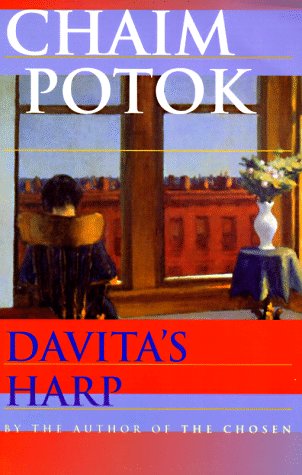
Davita's Harp by Chaim Potok

genre: fiction/Jewish Literature
rating: 5/5

When we meet Ilana Davita she is around 8 years old, in the late 1930s. She lives in New York City with her writer-activist parents in a non-religious household. The subject for which her parents have nearly radical zeal is, we learn through Davita's listening in to conversations and nightly meetings, communism. Her parent's decisions and activism, their friends and political struggles lie at the heart of Davita's young life - they move frequently and her nights are spent in a strange dream of "Spain" and "Fascism."

Before I read this book I had no sense that the second World War played such a vital role within the context of the story, and the communist movement within America at the start of the war is a perspective I have never read about before. Davita's entire life is shaped by involvement of people she loves within the War - either first-hand or through political leanings that taint the reputation and limits one's freedom.

What I particularly loved about this book is Potok's firm grasp of a young child's voice - their understandings and misunderstandings. The entire tale is told from Davita's point of view and we often share her frustration as she understands that very important things are happening and all she can do is wait to be told or try to figure it out for herself.

The characters in this story are deep and vivid. I loved Davita's depth-less thirst for knowledge - about the meanings of words, about the war, and, eventually of Judaism and the Torah. Her decision to become religious on her own, despite her mother's disapproval, felt very real and was a thread throughout the book that I found particularly engaging. The other characters - her parents, the friends of her parents - and even Davita's own friends, never felt false or caricatured. Each person was flawed and yet full of different strengths that Davita used to help find her own way through the trauma of war and of growing up in a tumultuous time.

Davita's Harp is amazing, it has an almost mystical quality about it. The harp itself, which hangs on a door and is an omen of both good and bad - but mostly is a tinkling constant throughout her childhood, becomes a haven within the story-world that Davita retreats to when life becomes more than her imagination can handle. Because her world is sometimes incredibly harsh and confusing, her search for truth and good occasionally becomes a struggle against those she loves and respects the most.

This is a story of the uselessness of war, the truth that can be found between the lines of stories and the pages of books, the beauty and reality of Judaism and the reconciliation of a girl with the world that she was born into. A triumph.

Sunday, December 28, 2008

Review: Sarah's Key

Sarah's Key
by Tatiana De Rosnay

Genre: WWII/Holocaust

Synopsis from bn.com:

Paris, July 1942: Sarah, a ten year-old girl, is brutally arrested with her family by the French police in the Vel’ d’Hiv’ roundup, but not before she locks her younger brother in a cupboard in the family's apartment, thinking that she will be back within a few hours.

Paris, May 2002: On Vel’ d’Hiv’s 60th anniversary, journalist Julia Jarmond is asked to write an article about this black day in France's past. Through her contemporary investigation, she stumbles onto a trail of long-hidden family secrets that connect her to Sarah. Julia finds herself compelled to retrace the girl's ordeal, from that terrible term in the Vel d'Hiv', to the camps, and beyond. As she probes into Sarah's past, she begins to question her own place in France, and to reevaluate her marriage and her life.

Tatiana de Rosnay offers us a brilliantly subtle, compelling portrait of France under occupation and reveals the taboos and silence that surround this painful episode.


Once again, I've read a historical novel about a subject of which I have no knowledge. But, the cool part is the present day character is a journalist researching the event, so that problem was solved. I did know that France was occupied by Germany, and I had the vague understanding that Jews were rounded up in France during this time, but I had never heard of this particular incident.

The structure of this book was interesting. The book could really be split into parts, which the author doesn't formally do. But the first part alternates between Sarah's story and Julia's story---past and present, first-hand and second-hand. Sarah's first-hand story was really the most compelling (and heartbreaking) part of the book and I was bored at first with Julia. But, later I grew to understand her better, especially after making the right choice (which I won't describe here, suffice to say I agreed with her decision and was relieved when she made it). The second part of the book deals with the present generations and how they cope with the new found knowledge of Sarah's ordeal. Julia becomes obsessed with uncovering what happened to Sarah and revealing that knowledge to Sarah's family. I wasn't sure how I felt about Julia revealing Sarah's history, but in the end, it is better to know the truth.

A quick note about the typography: Sarah's chapters were set in a oldshool-type font whereas Julia's had a more modern feel. At first I was thought there was something wrong with the book, but when I realized the purpose, I thought it was an interesting idea. I love it when publishers/authors/printers play around design.

I read this book in two days, and I would have read it in one if hadn't had to go to work. I absolutely loved it. Eventually, I want to read some more about the Vel' d'Hiv roundup and the occupation. The few Holocaust books I have read or heard about don't focus on this aspect of the war.

Rating: 5 out of 5. Highly recommended.

Saturday, April 5, 2008

The Diary of A Young Girl


Frank, Anne. 1952. The Diary of A Young Girl.

"You're reading that again?" That's what my mother said as she caught me reading Anne Frank. Like I haven't read anything but this one book in all these years. She's right. I have read Anne Frank's Diary of A Young Girl before. But some things are worth repeating. Diary of A Young Girl is one of them. The first time I read this book, I would have been in high school. Close enough to Anne's age to feel it--the drama of adolescence on top of extreme political and social upheaval. The Diary of A Young Girl captures both. The war. The threat of death. The threat of captivity. The threat of starvation and disease. But it also captures youth. What it means to be young, to be at that ever-awkward stage in life, in development. Always a me-in-the-making, never quite done finding out who you are and what you believe and what you want out of life. Anne could be any girl in any place and time. But because she was born a Jew. Because Hitler came to power. Her life--her perfectly ordinary life--was cut short.

The book begins in June of 1942. The last entry is in August of 1944. In these two years, these two turbulent years, Anne and her family and several other people as well all go into hiding in the Secret Annexe. Mr. and Mrs. Frank. Margot, the older sister. Mr. and Mrs. Van Daan. Their son Peter. And Mr. Dussel. Eight people. Cramped living conditions. This isn't reality tv. This is life and death. Yes, every person gets super-cranky and super-sensitive. But wouldn't you?

The reader gets a glimpse into the lives of real people through the eyes of one very young sometimes-mature, sometimes-immature girl. Anne Frank. Very famous now because of her diary. But just then--at the moment--one very ordinary girl with a natural desire to write a diary. I think most kids (or teens) at one time or another try their hand at keeping journals. Though perhaps now, blogging has replaced all that. Diaries are intimate, personal, private. Each entry is a snapshot into that one day, that one hour, that one moment. When you're young, (and even when you're older and supposedly all grown up) your mood, your outlook changes moment by moment, day by day. Happy one minute, miserable the next. Such is the case with Anne. Personally, I'm surprised that Anne had as many happy moments, contented moments, grateful moment in the Annexe as she did. I think it would only be natural to be unhappy, scared, miserable, depressed. Living in cramped quarters with people you dislike, people you disagree with, not being able to go outside, to go anywhere you want. Not having the freedom to move, to make noise when you want. To always be on alert. To always worry about the threat of discovery, the threat of capture, the threat of bombs blowing you to bits. High stress. Very high stress.

But this isn't just a book about war, about being Jewish, about being a victim. This book is so much more than that. It's a book about growing up. A book about changing from a girl into a young woman with hopes and dreams and fears and desires. It's a book about being that age. That extremely awkward stage of life. My mom thought all people of that age should be shipped off to junior high island until they grew out of it. That moody, I-hate-you, you-don't-understand-me stage. Anne was a work-in-progress. There's no doubt about it. When we first meet her, she's entering that phase of life. She doesn't get along with her mother. At all. She feels completely disconnected from her. Misunderstood. Unloved. Unwanted. Unappreciated. And her relationship with her father is better, but not perfect. Sometimes she feels the disconnect with him too. And her sister. She feels that her parents love her sister more. That her sister gets all the praise, the love, the positive attention. And she feels that she gets attacked, bombarded with negative attention--lectures, lectures, more lectures. Everyone is always out-to-get-her. But though this does seem to be Anne's story, Anne's predicament, by the second half of the book, Anne is growing, changing, maturing. She looks back over past entries and realizes that things are different, things have changed. And she realizes that most of the changes were in her. She is beginning to build, to establish a better relationship with her family. She is beginning to get comfortable in her own skin.

Anne is someone I think we all can relate to in a way. Anne was just a girl. A girl with interests and hobbies. Likes and dislikes. She could be anybody.

The Diary of A Young Girl was originally published in Holland in 1947. It was soon translated into other languages, including English, and printed in the United States. 1952 is the first publication date for the United States. Almost from the very beginning, it was recognized as a good book, a powerful book, a book worthy of time and attention and respect. But it's not without its enemies.

Though I'll never in a million years understand the mindset of those that challenge books, I'll never ever ever understand why Diary of A Young Girl is one of their targets. I just don't understand it. Can't understand it. One challenge brought against the book stated that it was pornographic. How??? Why??? Fortunately, the challenge failed, and the book stayed on the shelves. I suppose pornography is subjective. But a young girl writing about her period is so not pornographic! A young girl writing about her breasts developing? Not pornographic. A young girl writing about her first kiss? Not pornographic. There is no talk, no hint of sex in the book. Though Anne spends the last part of the book making out with Peter, the son of the Van Daans. But it's not pornographic in the slightest. Not unless it's the mention of Anne reading a book where there is mention of a woman selling her body. Or perhaps it is the conversation about the cat's male organs that is so offensive to folks? Whether the cat is a tom cat.

I could go on for hours about all the suffering the war has brought, but then I would only make myself more dejected. There is nothing we can do but wait as calmly as we can till the misery comes to an end. Jews and Christians wait, the whole earth waits, and there are many who wait for death. (64)

I see the eight of us with our "Secret Annexe" as if we were a little piece of blue heaven, surrounded by heavy black rain clouds. The round, clearly defined spot where we stand is still safe, but the clouds gather more closely about us and the circle which separates us from the approaching danger closes more and more tightly. (115)

But seriously, it would seem quite funny ten years after the war if we Jews were to tell how we lived and what we ate and talked about here. Although I tell you [the diary] a lot, still even so, you only know very little of our lives. (192)

And if I haven't any talent for writing books or newspaper articles, well, then I can always write for myself. . . I want to go on living after my death! And therefore I am grateful to God for giving me this gift, this possibility of developing myself and of writing, of expressing all that is in me. I can shake off everything if I write; my sorrows disappear, my courage is reborn. But, and that is the great question, will I ever be able to write anything great, will I ever become a journalist or a writer? I hope so, oh, I hope so very much. (197)

Tuesday, January 15, 2008

The Book Thief by Markus Zusak


Zusak, Markus. 2006. The Book Thief.

The Book Thief may just be the hardest book I've ever tried to review. It is beautiful. Though it can be ugly. It is intense. It is powerful. It is memorable. The first thing you should know about The Book Thief? It is narrated by Death. This is fitting in many ways since the setting is Nazi Germany during the Second World War. Death is the narrator, and he never lets you forget it. But there are many players--many characters--in the story that Death is relating to his audience all these years later. One of them is a girl, Liesel, and is known by Death as 'the book thief.' These thefts provide some structure to the text. (The structure is one of the odd things about the Book Thief. It isn't chronological. Death doesn't tell a story traditionally. He has his own way of jazzing it up, arranging it so it suits his needs and purposes.) The language, the style, is unique. I think it is written in such a way that you either really love it or you really don't. (It's written in such a way that you could almost open it to any page, and find a sentence or two or a whole paragraph that you want to just lift out and let resonate with you for a time.)

This is how it begins:

First the colors. Then the humans. That's usually how I see things. Or at least, how I try. Here is a small fact: you are going to die. I am in all truthfulness attempting to be cheerful about this whole topic, though most people find themselves hindered in believing me, no matter my protestations. Please, trust me. I most definitely can be cheerful. I can be amiable. Agreeable. Affable. And that's only the A's. Just don't ask me to be nice. Nice has nothing to do with me. (3)

It continues:

People observe the colors of a day only at its beginnings and ends, but to me, it's quite clear that a day merges through a multitude of shades and intonations, with each passing moment. A single hour can consist of thousands of different colors. Waxy yellows, cloud-spat blues. Murky darknesses. In my line of work, I make it a point to notice them. As I've been alluding to, my one saving grace is distraction. It keeps me sane. It helps me cope, considering the length of time I've been performing this job. The trouble is, who could ever replace me? Who could step in while I take a break in your stock-standard resort-style vacation destination, whether it be tropical or of the ski trip variety? The answer, of course, is nobody, which has prompted me to make a conscious, deliberate decision--to make distraction my vacation. Needless to say, I vacation in increments. In colors. Still it's possible that you might be asking, why does he even need a vacation? What does he need a distraction from? Which brings me to my next point. It's the leftover humans. The survivors. They're the ones I can't stand to look at, although on many occasions I still fail. I deliberately seek out the colors to keep my mind off them, but now and then, I witness the ones who are left behind, crumbling among the jigsaw puzzle of realization, despair, and surprise. They have punctured hearts. They have beaten lungs. Which in turn brings me to the subject I am telling you about tonight, or today, or whatever the hour and color. It's the story of one of those perpetual survivors--an expert at being left behind. It's just a small story really, about, among other things: a girl, some words, an accordionist, some fanatical Germans, a Jewish fish fighter, and quite a lot of thievery. (4-5)

Before the story gets underway, he invites the reader along for the journey:

Yes, often, I am reminded of her, and in one of my vast array of pockets, I have kept her story to retell. It is one of the small legion I carry, each one extraordinary in its own right. Each one an attempt, an immense leap of an attempt--to prove to me that you, and your human existence, are worth it. Here it is. One of a handful. The Book Thief. If you feel like it, come with me. I will tell you a story. I'll show you something. (14-15)

There is depth, substance, to these words, to this story. The descriptions. The details. The powerful sway of the words whether they're describing the beauty of love and family and friendship or capturing the ugly heaviness of hate, anger, and death. It's not an easy story to read. It's full of emotions. It's full of words. It's a book that at it's very heart and soul captures humanity in all its depths--the good, the bad, the ugly. Here is a book that captures what it means to be human.
One of the most memorable passages for me (224-236), and I hope this isn't much of a spoiler--is the hand drawn--hand written--portion written by "Max" for Liesel. I find it so powerful in its simplicity. So hauntingly beautiful. There is a second story specially written for Liesel by Max, this second one is found on pps 445-450. This is how that one begins, "There was once a strange, small man. He decided three important details about his life: 1) He would part his hair from the opposite side to everyone else. 2) He would make himself a small, strange mustache. 3) He would one day rule the world." (445)