When I began looking for books for the Jewish Literature Challenge, I thought immediately of Jane Yolen's The Devil's Arithmetic. It follows the story of a young Jewish girl named Hannah Stern. Hannah is tired of her Grandpa ranting about the Holocaust, and wishes she could spend Seder with her Gentile friends.
When her family asks her to symbolically open the door to invite the prophet Elijah in, she finds her self in the Poland of 1942. Everyone there thinks she's a young girl named Chaya, who survived the cholera that killed her family. She tries to explain to them that she's from a different time & place, but they think she's still feverish from her illness.
She slowly acclimates to her new surroundings, but during her uncle's wedding, the Nazis come to relocate the entire village to a concentration camp. Hannah tries to warn them of the dangers they face...starvation, gas chambers, hard work...but they don't believe her. After all, how would a young girl know of such things?
This book is a sobering look at just some of the realities of the Holocaust. It was the 1989 winner of the National Jewish Literature Award for children's literature. It's a very fast read, and its skillful writing pulls you into the story line immediately.
Showing posts with label Holocaust. Show all posts
Showing posts with label Holocaust. Show all posts
Saturday, June 12, 2010

Thursday, April 23, 2009
Emil and Karl
Glatshteyn, Yankev. 2006. Emil and Karl. Square Fish. (Roaring Book Press) 194 pages.
There is an immediacy and urgency to Emil and Karl. Written in 1938--in Yiddish--it was only recently (2006) translated and published in English. Set in Austria, Vienna to be exact. The Third Reich is in power, yet the horror of World War II has not yet dawned. The full wrath unleashed during the Holocaust--the organized full-scale murdering of the Jewish people*--has yet to begin. Though the hate is strong and ever-present. Meet Emil and Karl. Best friends. One is Jewish. The other is not. But despite it being in Karl's "best interest" to forget about his Jewish friend, Emil, he can't brush him off.
The seriousness of the novel is apparent from the very beginning. When we first meet Karl, he is alone.

"Karl sat on a low stool, petrified. The apartment was as still as death. He looked at the pieces of the broken vase scattered on the floor. Several times he reached out with one hand to pick up an overturned chair lying beside him. The chair looked like a man who had fallen on his face and couldn't get up. But each time Karl tried, he could only lift the chair up a little bit, and then it fell down again. It was even quieter in the kitchen and the bedroom--so quiet he was afraid to go in there. It wasn't that Karl minded being in the apartment by himself. He'd been left alone there more than once before; he could even go to bed by himself without being afraid. He wasn't scared of spooks or devils. Instead, he loved to stare, wide-eyed, into the darkness and make up stories." (1)
Why is he afraid? He witnessed what I imagine would have seemed the unthinkable. He watched them take his mother. He watched them hurt her. He heard their threats. He heard them threaten to come back...for him. In one night, everything in Karl's world is turned upside down.
When he does move, act, it is to go see his friend, Emil. He seeks the comfort of a true friend. What he learns is that Emil too has changed. Emil and Karl have an enemy in common now. Both have been orphaned. Both have only each other. Can these two children find a way to survive in this topsy-turvy ever-dangerous world where hate rules supreme?
What makes Emil and Karl unique--in my opinion--is its urgency. When it was written, this wasn't a distant event in the past. This wasn't historical fiction. This was current events. This was the threat and danger facing the world. And at the time it was written, it was a threat that had not been conquered. There's a suspenseful quality to it. A sense of the unknown. There was no happy ending light at the end of the tunnel to brighten it up. In fact, the worse was yet to come. It's an emotional novel; it's brilliantly and intelligently written to make you feel that you are there, that you are witness.
Tuesday, April 7, 2009
The Diary of a Young Girl
 by Anne Frank
ages: 12+
First sentence: "On Friday, June 12th I woke up at six o'clock and no wonder; it was my birthday."
Ack.
Let me say that again.
Ack.
If I had read this book when I was 12 or 13, I would have totally loved it. I would have completely identified with Anne, with her plight, with her suffering, with her angst, with her. I would have cried at the end. I would have swooned over her relationship with Peter, and the difficulties it presented.
But now...
I just felt like she's a whiny teenager who wasn't completely grateful that she didn't end up in a concentration camp for the whole war, and that she spent too much time whining about how horrible her parents (and the Van Daans) are. I felt like the book is only famous because she (in a cruel irony) died in a concentration camp three months before the Allieds liberated it. Yes, it was human, and real, and sometimes insightful. But I couldn't stand her. Or the book.
Which makes me feel guilty.
Oh, well. I missed the boat on this one.
Thursday, March 26, 2009
Maus by Art Spiegelman
Spiegelman, Art. 1986. Maus I: A Survivor's Tale: My Father Bleeds History.
This is a true-must-read of a book, well, a graphic novel to be exact. But still, must-read at all accounts. I loved the format of this one. No, not just the graphicness of it. But the framework of the story. How this novel is just as much about a father-son relationship--in all its complications--as it is about Jewishness, about the Holocaust. I also love the exploration of the psychology of it. So often with "Holocaust" books the issue of long-term effects, of psychological and emotional trauma that persists through the decades following such a horrific event, doesn't come up. It's a non-issue. Often memoirs are about a specific period of time. Liberation comes from either the Americans and the Russians. And voila. Horror over. But life isn't that easy.
In this first volume, we meet Artie, an artist, and his father, Vladek, a Holocaust survivor who is grumbling his way through a second marriage to a fellow-survivor, Mala. (Artie's mother, Anja, committed suicide in the late 1960s.) Artie seeks out his father in this volume wanting to hear his story, his past. Seeking answers to questions not only about his father, but his mother as well. Questions about the Nazis, the war, the Holocaust, how these two survived despite the odds. We, as readers, follow two stories, the contemporary setting where a son is asking some hard questions of his father and getting inspired to write about them in graphic novel form, and the historical setting--1930s and 1940s--where we meet his parents and learn their stories and backgrounds.
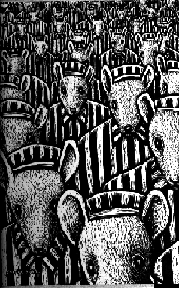
His father isn't in the best of health, and their relationship is strained. The book addresses the question of if parents ever really understand their children and/or if children can ever truly understand their parents. Can stressful tensions--ongoing issues and conflicts--ever be resolved peacefully? The drama is just as much about healing as it is the Nazis. And I think that is one of the reasons it's so powerful, so resonating. These characters--represented as mice in the novel--feel authentic. They're flawed but lovable. Their stories matter. (By the way, the Nazis are cats. The Polish are pigs. The French are frogs.)
The story is continued in Maus II.

Spiegelman, Art. 1991. Maus II: A Survivor's Tale: And Here My Troubles Began.
If Maus I was great, Maus II is even greater. If you thought the first one was heart-felt and moving, wait until you get to this one. Everything is more intense. The sorrows and griefs are even deeper; the actions even more troubling. For here we get to the heart of the story. The darkest place of all. Artie's father and mother have been captured by the Nazis and sent to a concentration camp. (In this graphic novel, the name is "Mauschwitz" instead of Auschwitz.) In the contemporary story line, we see that Artie's father isn't doing well; in fact, it becomes obvious, that he's dying. This complicates things tenfold. More guilt. More anger. More frustration. Even in fine health, Artie had a difficult time getting along with his father. Now, when his father perhaps needs him more than ever, he's crankier and grouchier and meaner than ever. Life isn't easy. Never easy. This is a complex novel--graphic novel--with heart and soul. Highly recommended.
Sunday, March 8, 2009
Sarah's Key
 book 3 of 5 for the War Through the Generations Challenge: WWII
book 2 of 5 for the Jewish Literature Challenge
genre: historical fiction
Let me start off by saying I could not put this book down. I must also say, that this book ripped my heart into tiny pieces and I'm not sure I'll ever be the same. Really. Maybe it's because I'm a mom or maybe I'm just an incredibly sensitive person. But I now have images in my brain that will never leave.
Sarah's Key takes place in France - switching between the modern day and the early days of World War II. I really like books like this, and I think the author did a fine job of transitioning us back and forth and filling in the blank spots. Sarah is a 10 year old girl living in Paris when her life is shattered by the French Police, who come into her home to arrest her parents and deport them, along with thousands of other French Jews. Her haunting story is intertwined with that of Julia, a journalist who stumbles upon Sarah's story as well as learning about the involvement of the French Police in the deportations.
Julia's fascination with the story leads her on a journey of not only self-discovery, but also a discovery of a her family's past, a country's past, and the consequences of a terrible secret.
Saturday, February 28, 2009
The Devil's Arithmetic
 "We all have such stories. It is a brutal arithmetic. But I--I am alive. You are alive. As long as we breathe, we can see and hear. As long as we can remember, all those gone before are alive inside of us."
Last year I read Jane Yolen's Briar Rose, a beautiful retelling of the fairy tale as a holocaust story. I have just finished listening to another one of her books, The Devil's Arithmetic, a story of the holocaust for young adult readers. It, too, was beautifully written and a very powerful story, and the audiobook was beautifully read by Barbara Rosenblat.
Hannah is a young girl who is "tired of remembering." She doesn't understand or appreciate the family rituals of remembering family members and friends that were lost in the holocaust, and she doesn't want to hear those stories of the past again and again. But during the family's Seder, when she "opens the front door to symbolically welcome the prophet Elijah, she is transported to a polish village -- and the year is 1942." She become "Chaya" (which means "life") and she experiences the holocaust first-hand.
It's a powerful experience to read this book or listen to the audiobook version. There's not a word out of place. It was honest and riveting, (which is such a Jane Yolen thing) and it was heartbreaking. But it was also full of hope ... if we remember.
Friday, February 13, 2009
Tropical Secrets

Engle, Margarita. 2009. (March 31, 2009 Pub.) TROPICAL SECRETS: HOLOCAUST REFUGEES IN CUBA. Henry Holt. 198 pages.
Read. This. Book. True, it won't be released for a few more weeks. But make note of it now to get to this one when you get the chance. Written by Margarita Engle--an acclaimed verse novelist--the book is the story of Daniel, a Jewish refugee, and the friends he makes in Cuba--Paloma and David. Daniel had no intentions of going to Cuba. When his parents tearfully sent him away--hoping and praying that at least their son may survive--this was right after the Night of Crystal or Broken Glass; they all thought that his ship would reach American shores--having heard stories of Lady Liberty and America being the place where all were welcome and the land where dreams could come true. But Daniel's ship was turned away from both Canada and the United States. His one chance for survival now depends on Cuba's mercy. The year is 1939. Does Daniel have a prayer of a chance?
This verse novel is told primarily in three voices: Daniel, Paloma, and David. Paloma is the daughter of "El Gordo" a man who is hoping that these refugees will make his wallet fat--very fat. The bigger the bribe, the higher the cost for a visa to enter the country, the richer he becomes. And with the Nazis even sending men to spread propaganda about Jews, the public isn't necessarily on their side--open to the idea of Jews being allowed to enter and settle there. Still, Daniel's ship is allowed. But we're not talking about one ship or even a dozen ships. David is a Jew--a Russian Jew who fled Russia many years before. Paloma helps David--and others--help the refugees providing food and clothing and friendship and support--teaching them Spanish, for example. The book is a novel about meaning things: hope, life, survival, friendship, tolerance. But it doesn't hide the fact that this was a very ugly, very brutal, very cruel time in history.
I don't know about you, but I'd certainly never heard about Cuba in regards to the Holocaust. It's interesting to see how this one island, small in size especially when comparing it to Canada and the United States, was able to provide some shelter to Jews fleeing Hitler. In the author's note she shares, "Despite tragedies and scandals, Cuba accepted 65,000 Jewish refugees from 1938 to 1939, the same number that was taken in by the much larger United States during the same time period. Overall, Cuba accepted more Jewish refugees than any other Latin American nation."
This book is fascinating. It's absorbing. Read. This. Book.
Saturday, January 31, 2009
Maus I and Maus II
 by Art Spiegelman
age: adult
First sentence, Maus I: "I went to see my father in Rego Park."
First sentence, Maus II: "Summer vacation."
These are two books, but like Persepolis, they're essentially one story, so they get lumped into one review.
 One review in which I'm not sure what the heck to say about the book. I'm always at a loss for words when it comes to the Holocaust; it's so depressing -- humanity at its worst -- that I almost would rather not go there. However, these graphic novels -- stark and depressing, yet somehow ultimately hopeful -- are worth reading.
I'm not sure if this is a story that couldn't have been told in a different form, but for what it's worth, it works as a graphic novel. It's spare, but then, I'm not sure the story of a survivor of Auschwitz could (or should) be anything but spare. Even though Spiegleman didn't go into detail about the situation, or the harshness, it was all there in its stark, depressing reality.
I was fascinated by the relationship between Spiegelman and his father -- how did the Holocaust fit into it? Did the Holocaust make his dad into the grumpy, miserly, bitter, racist person? He fits squarely into the Jewish stereotype, and yet I could sense that Spiegelman was trying to understand his father, understand why their relationship was so strained. I'm not sure any of us got any answers -- Spiegelman or the rreader -- but I appreciated not having it spelled out or sugarcoated in any way. Something like this shouldn't be.
I'm sorry I don't have more coherent thoughts about this one. I think it's an experience -- kind of like the Holocaust Museum is an experience -- that's beyond words. There are horrors out there, and sometimes it's good to face them. Even if its in a book.
Tuesday, December 30, 2008
In My Hands

Opdyke, Irene Gut. 1999. In My Hands: Memories of a Holocaust Rescuer.
I did not ask myself, Should I do this? But, How will I do this? Every step of my childhood had brought me to this crossroad; I must take the right path, or I would no longer be myself. You must understand that I did not become a resistance fighter, a smuggler of Jews, a defier of the SS and the Nazis, all at once. One's first steps are always small: I had begun by hiding food under a fence. Now I was making plans to... (142-143)
In My Hands is nonfiction--a memoir--and it's a powerful one. Full of descriptive images you might wish you'd never seen. But it's an important work, a necessary one. Our narrator, Irene Gut, was a Polish girl--a young woman training to be a nurse when the war burst into her life. The conflict between Germany and Russia stripping her of her childhood in more ways than one. Her account of what happened during the war years are powerful and haunting. But there is nothing over-the-top either. It's straightforward, spare, even.
This is her description of the purging of the Poland of Jews (I believe we're speaking of the ghettos.)
The gates were dragged open, and the Jewish prisoners were forced out through a gauntlet, while the guards beat at them with their rifle butts. An old man, tottering with a cane, was not fast enough, and a guard shot him on the spot. In vain, women tried to protect their small children from blows, men tried to shield their old fathers. But every time someone stumbled and fell under the beatings, shots rang out. The street was paved with bodies, and still the Jews were forced to march out over them.
We watched this from our windows in a paralysis of horror. We could do nothing but watch. We could not even pull back from the glass to keep hidden. An old rabbi carrying the Torah stopped to help a young woman with a shrieking toddler, and all three were shot. A graybeard in a faded uniform of the Polish army from the last war limped past the guards, and he, too, was not fast enough. The sun shone down on all of them, and the dust settled in pools of blood.
By this time, the four of us were crying uncontrollably. Helen was on her knees, sobbing in her mother's arms. Janina turned her face away. But I watched, flattening myself against the window. As I pressed against the glass, I saw an officer make a flinging movement with his arm, and something rose up into the sky like a fat bird. With his other hand he aimed his pistol, and the bird plummeted to the ground beside its screaming mother, and the officer shot the mother, too. But it was not a bird. It was not a bird. It was not a bird. (116-117)
This is how she sums it up, "We did not speak of what we had seen. At the time, to speak of it seemed worse than sacrilege: We had witnessed a thing so terrible that it acquired a dreadful holiness. It was a miracle of evil. It was not possible to say with words what we had witnessed, and so we kept it safely guarded until the time we could bring it out, and show it to others, and say, "Behold. This is the worst thing man can do."" (118)
© Becky Laney of Becky's Book Reviews
Sunday, December 28, 2008
Review: Sarah's Key
 Sarah's Key
by Tatiana De Rosnay
Genre: WWII/Holocaust
Synopsis from bn.com:
Paris, July 1942: Sarah, a ten year-old girl, is brutally arrested with her family by the French police in the Vel’ d’Hiv’ roundup, but not before she locks her younger brother in a cupboard in the family's apartment, thinking that she will be back within a few hours.
Paris, May 2002: On Vel’ d’Hiv’s 60th anniversary, journalist Julia Jarmond is asked to write an article about this black day in France's past. Through her contemporary investigation, she stumbles onto a trail of long-hidden family secrets that connect her to Sarah. Julia finds herself compelled to retrace the girl's ordeal, from that terrible term in the Vel d'Hiv', to the camps, and beyond. As she probes into Sarah's past, she begins to question her own place in France, and to reevaluate her marriage and her life.
Tatiana de Rosnay offers us a brilliantly subtle, compelling portrait of France under occupation and reveals the taboos and silence that surround this painful episode.
Once again, I've read a historical novel about a subject of which I have no knowledge. But, the cool part is the present day character is a journalist researching the event, so that problem was solved. I did know that France was occupied by Germany, and I had the vague understanding that Jews were rounded up in France during this time, but I had never heard of this particular incident.
The structure of this book was interesting. The book could really be split into parts, which the author doesn't formally do. But the first part alternates between Sarah's story and Julia's story---past and present, first-hand and second-hand. Sarah's first-hand story was really the most compelling (and heartbreaking) part of the book and I was bored at first with Julia. But, later I grew to understand her better, especially after making the right choice (which I won't describe here, suffice to say I agreed with her decision and was relieved when she made it). The second part of the book deals with the present generations and how they cope with the new found knowledge of Sarah's ordeal. Julia becomes obsessed with uncovering what happened to Sarah and revealing that knowledge to Sarah's family. I wasn't sure how I felt about Julia revealing Sarah's history, but in the end, it is better to know the truth.
A quick note about the typography: Sarah's chapters were set in a oldshool-type font whereas Julia's had a more modern feel. At first I was thought there was something wrong with the book, but when I realized the purpose, I thought it was an interesting idea. I love it when publishers/authors/printers play around design.
I read this book in two days, and I would have read it in one if hadn't had to go to work. I absolutely loved it. Eventually, I want to read some more about the Vel' d'Hiv roundup and the occupation. The few Holocaust books I have read or heard about don't focus on this aspect of the war.
Rating: 5 out of 5. Highly recommended.
Saturday, December 27, 2008
Yellow Star
 by Jennifer Roy
ages 9-12
This is not a happy book. Then again, what book about the Holocaust is a happy book? Granted, this one has a happy ending -- it's a story based on the life of the author's aunt, and she survived -- but getting there is harsh, depressing, and painful. Which means that Roy did an incredible job depicting the life and circumstances of her aunt Syvia's childhood.
I'm trying to figure out a way to sum up the book without giving a mini-history lesson. For those who don't know their World War II history, this story of one of the 800 survivors -- only 12 of which were children -- of the Lodz, Poland ghetto is not a fun one to read. Written in verse, I think to mimic the spare conditions of Syvia's life, Roy captures the faith and family togetherness in the face of pure hopelessness quite well. There were parts that made me cringe -- the Nazis deported all the children at one point, tearing them from their family; it was only through the courage and resorcefulness of Syvia's father (and herself) that she managed to survive that time -- and others that made me cry. I am amazed at Syvia, and at the luck -- miracles? providence? chance? -- that she had during her life. There were so many (more than 270,000 people lived in the ghetto at one time) that didn't get her chance.
I'm not sure I can separate a critique of the book (can I say that in this instance I felt the verse was good, but unnecessary?) from the life. It's a good book -- not a great one -- with a worthy story. And a story worth reading. Which makes the book worth reading, too.
Saturday, May 3, 2008
Lynne's Reviews and Wrap-Up
Lynne from Lynne's Little Corner of the Web finished this challenge a long time ago:
Reviews:
700 Sundays by Billy Crystal
A Stone for Danny Fisher by Harold Robbins
Eyewitness Auschwitz: Three Years in the Gas Chamber by Filip Muller
Empty the Ocean with a Spoon by Rosalie Sogolow
Jewish Culture and Customs by Steve Herzig
Wrap-up
Reviews:
700 Sundays by Billy Crystal
A Stone for Danny Fisher by Harold Robbins
Eyewitness Auschwitz: Three Years in the Gas Chamber by Filip Muller
Empty the Ocean with a Spoon by Rosalie Sogolow
Jewish Culture and Customs by Steve Herzig
Wrap-up
Wednesday, April 23, 2008
Hanna's Suitcase, by Karen Levine

Hana's Suitcase, by Karen Levine, published in 2007, is the true story of a young Czech girl named Hana Brady, who was taken away by the Nazis along with her older brother George, and that of her suitcase, which through a chain of events ended up in Japan. It is also the story of a Japanese woman's efforts to find out about Hana- who she was and what happened to her. The book is incredibly moving. Illustrated with photographs of Hana and her family as well as the Holocaust center in Japan where her suitcase is found, Levine tells Hana's story in parallel with the story of the efforts to learn about her. This structure sets up two crushing waves of emotion that left me in tears by the end. It's bittersweet tragedy, told with beauty and sensitivity.
Tuesday, April 22, 2008
Saturday, April 19, 2008
The Hiding Place by Corrie ten Boom
I'm really not sure how many folks are familiar with Corrie ten Boom and her fascinating story, The Hiding Place. She was a Dutch Christian who, with her father and sister, hid Dutch Jews in their Haarlem house during World War II and Hitler's terrifying reign.
Corrie lost her father during their time in prison, and then her sister Betsie passed away while they were in the Ravensbruck concentration camp. Corrie lived until 1983.
I really love this story. I saw the film "The Hiding Place" when I was growing up, and I subsequently read the book. After also reading Anne Frank's diary, I became fascinated with Jewish culture (which makes me a bit of an oddity as a Christian minister's wife, actually) and the sadness of the Holocaust, which is the most horrible crime against humanity in the 20th century.
I recomend this book, because it is a personal story. It shows that that well-meaning Christians died to help save Jews. And it shows the love of God.
Corrie lost her father during their time in prison, and then her sister Betsie passed away while they were in the Ravensbruck concentration camp. Corrie lived until 1983.
I really love this story. I saw the film "The Hiding Place" when I was growing up, and I subsequently read the book. After also reading Anne Frank's diary, I became fascinated with Jewish culture (which makes me a bit of an oddity as a Christian minister's wife, actually) and the sadness of the Holocaust, which is the most horrible crime against humanity in the 20th century.
I recomend this book, because it is a personal story. It shows that that well-meaning Christians died to help save Jews. And it shows the love of God.
Thursday, April 17, 2008
I Have Lived A Thousand Years by Livia Bitton-Jackson

Bitton-Jackson, Livia. 1997. I Have Lived A Thousand Years.
I Have Lived A Thousand Years: Growing Up in the Holocaust is the memoir of Elli L. Friedmann. Born in Czechoslovakia, Elli along with her family were taken to Auschwitz when the ghettos were liquidated in 1944. The book covers the years 1944-1945, although it hints at what came before and what comes after. The book concludes with Elli and her remaining family members arriving in America in 1951.
Her prose is concise and powerful. As a child, she loved to write poems. And this is evident in her memoir. The imagery is strong; there is power in her words. The emotions resonate. When our story opens she is around the age of 13. Here is her description of when the Nazis came and her school was closed, "I weep and weep. I weep for my classroom, which is no longer my classroom. For the school that will never be my school again. I weep for my life, which will never be the same." A bit further on we read her description of what it was like to be shown where the family's treasure was buried. The unspoken words being that she may be the only one to survive. "I don't want to know the spot! I don't want to be the one to survive! I don't want to survive alone! Alone, I don't want to live. Oh God, I don't want to live if you don't! I don't want to know about anything! I don't want to know!"
Her descriptions are so powerful, so real. The way they are written, so straight-forward, so concise, instantly put me in her shoes. The people aren't just numbers, aren't just statistics, aren't just nameless, faceless strangers. They're real; they matter; their stories, their lives count.
This was a very powerful book for me. Elli's determination to survive, to ensure her mother's survival is so courageous, so incredible. The fact that hope and strength and courage and dignity can survive in the midst of such horror is amazing to me. Wonderfully amazing to me.
This book is definitely a must read.
The title of the book comes from the liberation scene. Elli and her brother and mother are all together. They are trying to survive until they can be liberated. Freedom is within their grasp, yet there is still danger and fear on the prowl. When they are liberated, Elli is taken for an old woman. They think she is a woman who is in her sixties, they're flabbergasted to learn that she is just fourteen years old. She says, "I am fourteen years old, and I have lived a thousand years." What great imagery.
Tuesday, April 15, 2008
Emil and Karl by Yankev Glatshteyn

Stars: *****
Unlike most books about the Holocaust, this one was written before WW II even started. It was originally written in Yiddish and was translated by Jeffrey Shandler into English which is how I read it.
Something else that makes this book different from all the others is that it was written for children in Jewish School in America to learn more about what was happening to kid’s their age in Europe. The author did a good job of putting in just the right amount of detail about the horrid things that happened to Jews. Enough to make it clear how things were but not too much so that the kids would go home scared and have nightmares. Written from a 3rd person point of view so that you get to hear what the thoughts are from both boys. I think this was a good choice.
Subscribe to:
Posts (Atom)