Spiegelman, Art. 1986. Maus I: A Survivor's Tale: My Father Bleeds History.
This is a true-must-read of a book, well, a graphic novel to be exact. But still, must-read at all accounts. I loved the format of this one. No, not just the graphicness of it. But the framework of the story. How this novel is just as much about a father-son relationship--in all its complications--as it is about Jewishness, about the Holocaust. I also love the exploration of the psychology of it. So often with "Holocaust" books the issue of long-term effects, of psychological and emotional trauma that persists through the decades following such a horrific event, doesn't come up. It's a non-issue. Often memoirs are about a specific period of time. Liberation comes from either the Americans and the Russians. And voila. Horror over. But life isn't that easy.
In this first volume, we meet Artie, an artist, and his father, Vladek, a Holocaust survivor who is grumbling his way through a second marriage to a fellow-survivor, Mala. (Artie's mother, Anja, committed suicide in the late 1960s.) Artie seeks out his father in this volume wanting to hear his story, his past. Seeking answers to questions not only about his father, but his mother as well. Questions about the Nazis, the war, the Holocaust, how these two survived despite the odds. We, as readers, follow two stories, the contemporary setting where a son is asking some hard questions of his father and getting inspired to write about them in graphic novel form, and the historical setting--1930s and 1940s--where we meet his parents and learn their stories and backgrounds.
His father isn't in the best of health, and their relationship is strained. The book addresses the question of if parents ever really understand their children and/or if children can ever truly understand their parents. Can stressful tensions--ongoing issues and conflicts--ever be resolved peacefully? The drama is just as much about healing as it is the Nazis. And I think that is one of the reasons it's so powerful, so resonating. These characters--represented as mice in the novel--feel authentic. They're flawed but lovable. Their stories matter. (By the way, the Nazis are cats. The Polish are pigs. The French are frogs.)
The story is continued in Maus II.

Spiegelman, Art. 1991. Maus II: A Survivor's Tale: And Here My Troubles Began.
If Maus I was great, Maus II is even greater. If you thought the first one was heart-felt and moving, wait until you get to this one. Everything is more intense. The sorrows and griefs are even deeper; the actions even more troubling. For here we get to the heart of the story. The darkest place of all. Artie's father and mother have been captured by the Nazis and sent to a concentration camp. (In this graphic novel, the name is "Mauschwitz" instead of Auschwitz.) In the contemporary story line, we see that Artie's father isn't doing well; in fact, it becomes obvious, that he's dying. This complicates things tenfold. More guilt. More anger. More frustration. Even in fine health, Artie had a difficult time getting along with his father. Now, when his father perhaps needs him more than ever, he's crankier and grouchier and meaner than ever. Life isn't easy. Never easy. This is a complex novel--graphic novel--with heart and soul. Highly recommended.
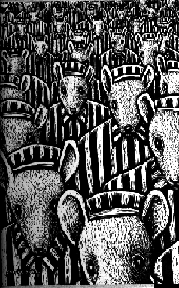


 Brilliant. Powerful. Poignant. Intensely personal. In graphic novel format and the winner of a Pulitzer Prize Special Award in 1992, Maus is Vladek Spiegelman's story of his survival of Auschwitz during World War II. It is also a story of the father-son relationship between Vladek and Art. In this first book, Art interviews his father about his intense past. Each nationality is represented as a different animal. The Jews are mice, the Germans are cats, and the Poles are pigs. We not only see the absolute horrors of Auschwitz from a survivor's viewpoint, we also see one survivor's son deal with the guilt of just being the son of a survivor.
 The continuation of Maus, and subtitled And Here My Troubles Began (From Mauschwitz to the Catskills and Beyond), Maus II is every bit as astounding as Maus, and the two books really should be read together. In this book we learn more about the end of Vladek's life, and one of the questions that is posed from the book is: