Showing posts with label Corinne. Show all posts

Thursday, March 26, 2009

People of the Book by Geraldine Brooks

genre: fiction/historical fiction
rating: 4/5

A centuries old manuscript is at the crux of this book - illustrated and written in Hebrew, it's a once-in-a-lifetime chance for Australian conservationist Hanna Heath. Her conservation efforts lead her to clues within the book that shed light on who might have handled the book, where it traveled from and who drew the amazing illuminations. The narrative does one of my favorite things: switches us from chapter to chapter between the present time period and different periods of the book's history: each clue Hanna finds is more background about the book and the hands that have held it.

For the most part, it is a gripping story. We travel through centuries of time and all over the world as we follow Hanna and her book. Some sections were more engaging than others (a few were a bit raunchy), but it always kept my attention and I was always pleased whether a chapter took me back to Hanna or to somewhere (and sometime) new. The clues themselves were interesting and parts of the book felt like an episode of CSI or some other forensics tv show, but since I like that, it added to the book for me.

Hanna is a challenging character, bordering on emotionally dysfunctional. Sometimes her personality grated on me - and other times I really could relate to her. I like how she made a point of explaining her "Aussi-ness" and differentiated, at times, between American/British/Australian ways of thinking and doing things. Her back-story and the things she learns about her past along the way flowed well enough with the book plot and I never wanted to put it down.

While the ending wasn't what I'd imagined it would be, it worked. I thought this was a good read.

Sunday, March 22, 2009

The Red Tent by Anita Diamant

genre: historical fiction
rating: 3.5/5

The Red Tent tells a fictionalized version of the story of Dinah, daughter of the Leah who is the sister of Rachel and the husband of Jacob from the Old Testament. Because it is based on the Biblical story, many of the characters and major events are familiar to those of us familiar with the Bible; what makes this story different is that it is told from Dinah's perspective, drawing readers into what the female half of the world may have been doing during Biblical times.

Dinah is a daughter between two worlds - the world of the Red Tent, where goddesses are worshiped and where the lives of women revolve around the cycles of the moon and the harvest. In this sanctuary, the female form and purpose is a sacred thing. Contrast this to the world outside the Red Tent, where women are bought and sold, beaten and worked into old age. As she grows and becomes aware of the nuances of family relationships, she begins to see divisions and unrest among her mothers, father and brothers. When tragedy forces Dinah to make a horrendous choice, her life and that of her family's will never be the same.

I liked it, as much this time as the first time I read it, years ago. I thought about it when I had to put it down and I wanted to know the end of Dinah's tale. I enjoy reading about familiar characters from fresh points of view and I think Diamant created a very realistic rendition of Canaanite society and of the world of Jacob, his wives and family. I loved that so much of the book had to do with birthing and midwifery and relationships between women and between mothers and children. Dinah's relationships were intricate and her friendships were a pleasure to read about.

I was sometimes frustrated that so many of her characters seemed hopelessly flawed, almost unrealistically so and the graphic nature of some scenes detracted from the story, for me. It's certainly an earthy story, set in a time when the old gods and goddesses are being replaced by the one God of Abraham, Issac and Jacob, creating an interesting juxtaposition between "new" ways and the "old" ways. As much as the "earthy-ness" bothered me, I can't deny that Diamant has a way with words. One of my favorite paragraphs, written about the birth of a child:
There should be a song for women to sing at this moment, or a prayer to recite. But perhaps there is none because there are no words strong enough to name that moment. Like every mother since the first mother, I was overcome and bereft, exalted and ravaged.
I recommend this with caution. There is much honeymooning and lovemaking and we don't have to imagine much. That being said, there much to appreciate in this story about the power and resilience of the female spirit.

Sunday, March 8, 2009

Sarah's Key

book 3 of 5 for the War Through the Generations Challenge: WWII
book 2 of 5 for the Jewish Literature Challenge
genre: historical fiction

Let me start off by saying I could not put this book down. I must also say, that this book ripped my heart into tiny pieces and I'm not sure I'll ever be the same. Really. Maybe it's because I'm a mom or maybe I'm just an incredibly sensitive person. But I now have images in my brain that will never leave.

Sarah's Key takes place in France - switching between the modern day and the early days of World War II. I really like books like this, and I think the author did a fine job of transitioning us back and forth and filling in the blank spots. Sarah is a 10 year old girl living in Paris when her life is shattered by the French Police, who come into her home to arrest her parents and deport them, along with thousands of other French Jews. Her haunting story is intertwined with that of Julia, a journalist who stumbles upon Sarah's story as well as learning about the involvement of the French Police in the deportations.

Julia's fascination with the story leads her on a journey of not only self-discovery, but also a discovery of a her family's past, a country's past, and the consequences of a terrible secret.

Wednesday, January 7, 2009

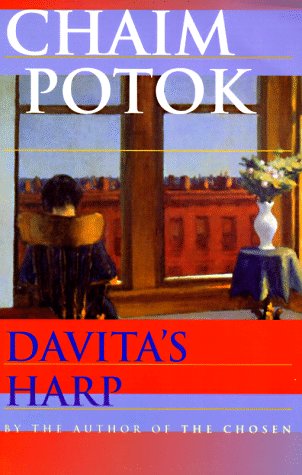
Davita's Harp by Chaim Potok

genre: fiction/Jewish Literature
rating: 5/5

When we meet Ilana Davita she is around 8 years old, in the late 1930s. She lives in New York City with her writer-activist parents in a non-religious household. The subject for which her parents have nearly radical zeal is, we learn through Davita's listening in to conversations and nightly meetings, communism. Her parent's decisions and activism, their friends and political struggles lie at the heart of Davita's young life - they move frequently and her nights are spent in a strange dream of "Spain" and "Fascism."

Before I read this book I had no sense that the second World War played such a vital role within the context of the story, and the communist movement within America at the start of the war is a perspective I have never read about before. Davita's entire life is shaped by involvement of people she loves within the War - either first-hand or through political leanings that taint the reputation and limits one's freedom.

What I particularly loved about this book is Potok's firm grasp of a young child's voice - their understandings and misunderstandings. The entire tale is told from Davita's point of view and we often share her frustration as she understands that very important things are happening and all she can do is wait to be told or try to figure it out for herself.

The characters in this story are deep and vivid. I loved Davita's depth-less thirst for knowledge - about the meanings of words, about the war, and, eventually of Judaism and the Torah. Her decision to become religious on her own, despite her mother's disapproval, felt very real and was a thread throughout the book that I found particularly engaging. The other characters - her parents, the friends of her parents - and even Davita's own friends, never felt false or caricatured. Each person was flawed and yet full of different strengths that Davita used to help find her own way through the trauma of war and of growing up in a tumultuous time.

Davita's Harp is amazing, it has an almost mystical quality about it. The harp itself, which hangs on a door and is an omen of both good and bad - but mostly is a tinkling constant throughout her childhood, becomes a haven within the story-world that Davita retreats to when life becomes more than her imagination can handle. Because her world is sometimes incredibly harsh and confusing, her search for truth and good occasionally becomes a struggle against those she loves and respects the most.

This is a story of the uselessness of war, the truth that can be found between the lines of stories and the pages of books, the beauty and reality of Judaism and the reconciliation of a girl with the world that she was born into. A triumph.