Fax Me a Bagel by Sharon Kahn
I read the fourth in this series last year for this same challenge.
Can I just say that I love Ruby? Ruby is the best minister's wife protagonist I have read in a while. She is so honest about who she is, I hope that someday I can also be that self-aware.
I really enjoyed this novel. It's a great cozy mystery, without icky details (well, unless you count Rabbi Kevin, but I digress...), and a great mystery and some insight into synagogue life (which is not all that different from church life, really...and again, I digress...).
Such fun!
Monday, April 20, 2009

Sunday, April 19, 2009
Almost Done
Well the challenge is almost over (although if I hadn't messed the date up, it would have already been over)
I was supposed to participate but haven't read a single Jewish book yet so I'm obviously not going to be done in time. That's okay, I have some on my agenda to read this year and I'll keep running this challenge every year.
For those interested in children's Jewish books, I found this blog on Jewish Books for Children. I'll add that to the side.
Do your best to finish but don't worry if you don't make it. You can keep adding your reviews even past the finish date. Just have fun with it and enjoy new books.
If you do a wrap-up post, I'll put a finish post up soon that you can link to your wrap-up post or you can just post (or repost) it here, whichever. Let me know if you have any suggestions for next time.
I was supposed to participate but haven't read a single Jewish book yet so I'm obviously not going to be done in time. That's okay, I have some on my agenda to read this year and I'll keep running this challenge every year.
For those interested in children's Jewish books, I found this blog on Jewish Books for Children. I'll add that to the side.
Do your best to finish but don't worry if you don't make it. You can keep adding your reviews even past the finish date. Just have fun with it and enjoy new books.
If you do a wrap-up post, I'll put a finish post up soon that you can link to your wrap-up post or you can just post (or repost) it here, whichever. Let me know if you have any suggestions for next time.
Tuesday, April 14, 2009
 Another author I have just discovered, and am so glad I did, is Adèle Geras. I've been aware of her name, seen some of her books, but had never read anything by her. I just finished a most delightful books of stories by her, and can't wait to read more of her work! Here's what Booklist said about My Grandmother's Stories: A Collection of Jewish Folktales.
“Like all good stories in the Yiddish tradition, the pleasure of Geras’ collection comes as much from the telling as from what happens. These are stories within stories: the narrator remembers herself as a young child hearing them from her grandmother, as they cooked, hung up laundry, prepared for the Sabbath, or cleaned house for Passover. This framing of the stories emphasizes their continuing pleasure across generations; and customs, idioms, traditions, even recipes that the Jews brought with them from Eastern Europe are an unobtrusive part of the telling.”
Each story was inspired by Geras's grandmother, and each one teaches a lesson in the kind and endearing way a grandmother would teach her beloved grandchildren. This collection was illustrated by Anita Lobel, whose illustrations were as delightful as the stories.
This book won the Sydney Taylor Book Award in 1991. I read it for Callista's Jewish Literature Challenge, and it was a wonderful find.

Freefall by Anna Levine
 I read a review of Anna Levine's YA novel about an Israeli girl and knew I had to give it a try. Aggie, who lives in Jerusalem, will soon be drafted into the Israeli Army (all Israeli citizens serve their country for two or three years after high school). While she isn't sure exactly what she wants to do, she's pretty sure she doesn't want to push paper in an office for two years. She also isn't exactly sure that she isn't attracted to her best friend's older brother Noah who is already in the middle of his military service. Though her parents completely oppose it, Aggie decides she wants to try out to be part of an elite squad and is determined to prove herself.
I liked Aggie. She seemed like a good girl with a reasonably frustrating home life. She was tough and yet had enough indecision in her to make her be a real teenager. I loved the descriptions of Israel and the information about the Israeli Army was interesting. Also the romance was fantastic.
Wednesday, April 8, 2009

Tuesday, April 7, 2009
The Diary of a Young Girl
 by Anne Frank
ages: 12+
First sentence: "On Friday, June 12th I woke up at six o'clock and no wonder; it was my birthday."
Ack.
Let me say that again.
Ack.
If I had read this book when I was 12 or 13, I would have totally loved it. I would have completely identified with Anne, with her plight, with her suffering, with her angst, with her. I would have cried at the end. I would have swooned over her relationship with Peter, and the difficulties it presented.
But now...
I just felt like she's a whiny teenager who wasn't completely grateful that she didn't end up in a concentration camp for the whole war, and that she spent too much time whining about how horrible her parents (and the Van Daans) are. I felt like the book is only famous because she (in a cruel irony) died in a concentration camp three months before the Allieds liberated it. Yes, it was human, and real, and sometimes insightful. But I couldn't stand her. Or the book.
Which makes me feel guilty.
Oh, well. I missed the boat on this one.
Monday, April 6, 2009
People of the Book
 Geraldine Brooks based this amazing novel on the story of an actual book called the Sarajevo Haggadah (a book which describes how the Passover Seder is to be performed). Hanna Heath is an expert in old books - a serious expert. She is invited to Bosnia to analyze a rare volume and try to determine its authenticity and its origin. Using tiny artifacts found in the book (a hair, a piece of an insect wing, salt, and a wine stain) to trace its history.
The story is told backwards with Hanna's experiences interspersed with glimpses into the book's past, the most recent events explored first. The Haggadah survived some of the world's most tragic moments and been protected by some very brave individuals, several of them not Jewish. Hanna's family life has been less than ideal and as she studies the Haggadah she is forced to confront some of her most difficult relationships.
People of the Book was an intriguing and painful book to read. Some of the scenes I couldn't even get through because they were so disturbing. The interweaving of Hanna's life and the backwards progression of the book worked very well. I have enjoyed all of Geraldine Brooks' other books and this was no exception.
I will say though, if you want a much better review of this book, scroll down and see my sister Corinne's thoughts!
Thursday, April 2, 2009
NOTE to all participants
Somehow I messed up as Passover ends April 16 this year. I'm not sure how I managed to mess up the dates but don't worry, the challenge will still end as planned.
To finish the challenge, you need to finish READING the books in time, but you don't have to have your reviews posted (if you're doing reviews) by that time.
To finish the challenge, you need to finish READING the books in time, but you don't have to have your reviews posted (if you're doing reviews) by that time.
Wednesday, April 1, 2009
The Family Fortune
The Family Fortune by Laurie Horowitz
Very cute chick lit story. I purchased it in the first place because it was based on Persuasion, but I ended up enjoying it for its own sake in the end.
summary from Amazon.com, Publishers Weekly:
Based loosely on Jane Austen's Persuasion, Horowitz's cheeky, uneven debut novel follows Jane Fortune, a Bostonian with a romantic crisis. The 38-year-old founder and editor of a prominent literary journal, Euphemia Review, Jane pines for true love while devouring novels and dealing with the financial woes of her once wealthy family, which force them out of their Beacon Hill home. When an enigmatic writer named Jack Reilly submits a brilliant story to a Euphemia contest, Jane is intrigued; when she learns that he lives off the grid, she becomes infatuated and tries to track him down. But Jane still carries a torch for her first love, Max Wellman, a successful novelist who got his start in Euphemia. Jane's narrative voice is natural and lively, but the plot unfolds in fits, careening between Jane's romantic adventures and the Fortune family foibles. Horowitz captures her "lifestyles of the rich and literary" milieu, but otherwise her Austen tribute is transparent and unnecessary; for all the highbrow window dressing, this is pure chick lit, featuring characters with the depth of a teacup and a "girl loses boy, girl finds boy" plot. Horowitz continues the tradition ably, promising plenty as soon as she ditches the lit-crit posturing and embraces her inner Lauren Weisberger.
Very cute chick lit story. I purchased it in the first place because it was based on Persuasion, but I ended up enjoying it for its own sake in the end.
summary from Amazon.com, Publishers Weekly:
Based loosely on Jane Austen's Persuasion, Horowitz's cheeky, uneven debut novel follows Jane Fortune, a Bostonian with a romantic crisis. The 38-year-old founder and editor of a prominent literary journal, Euphemia Review, Jane pines for true love while devouring novels and dealing with the financial woes of her once wealthy family, which force them out of their Beacon Hill home. When an enigmatic writer named Jack Reilly submits a brilliant story to a Euphemia contest, Jane is intrigued; when she learns that he lives off the grid, she becomes infatuated and tries to track him down. But Jane still carries a torch for her first love, Max Wellman, a successful novelist who got his start in Euphemia. Jane's narrative voice is natural and lively, but the plot unfolds in fits, careening between Jane's romantic adventures and the Fortune family foibles. Horowitz captures her "lifestyles of the rich and literary" milieu, but otherwise her Austen tribute is transparent and unnecessary; for all the highbrow window dressing, this is pure chick lit, featuring characters with the depth of a teacup and a "girl loses boy, girl finds boy" plot. Horowitz continues the tradition ably, promising plenty as soon as she ditches the lit-crit posturing and embraces her inner Lauren Weisberger.
Sunday, March 29, 2009
The Last Unicorn by Peter S. Beagle
 I am ashamed that I haven't read this before. I was a great devotee of the movie when I was young and it wasn't until I was a teen that I even realized there WAS a book. But even then, I remember checking it out once and trying it, but just preferring the movie. Silly girl. The book is just as good and definitely more profound. Or, maybe, I have just lived enough now to see that it IS profound.
The last unicorn doesn't know she is the last until she hears a hunter speak the words. Her journey to find out the truth about unicorns in the world leads her on a journey into the depths of the human condition. She gathers with her those who can see her for what she truly is: the kind and bumbling Schmedrick, the Magician, and Molly Grue, the crabby scullery girl. With these two by her side she travels towards the realm of King Haggard and his terrifying Red Bull. What she learns along the way about herself and the ways of humans will change the land forever.
What makes this book such a classic? Is it the complex characters? The unicorn is at once both naive and wise, teaching us what is human by putting words to what we have and what we lack. Is it the magic itself, fleeting and powerful - at the ready for some but tantalizingly fickle with others? Or perhaps it's because it is a tale of finding what is beautiful, old, and good and restoring it to its rightful place - but first having to learn what is worth living and dying for.
The writing is witty, lyrical and powerful. If you have seen the movie, you'll hear voices in your head as you read text that was lifted word for word and put into the movie. But even if you haven't - if you love tales of magic and love, unicorns and heroes - you should open the pages of this one and take the journey. You won't forget it.
Thursday, March 26, 2009
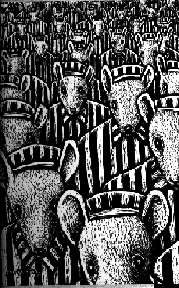
Maus by Art Spiegelman
Spiegelman, Art. 1986. Maus I: A Survivor's Tale: My Father Bleeds History.
This is a true-must-read of a book, well, a graphic novel to be exact. But still, must-read at all accounts. I loved the format of this one. No, not just the graphicness of it. But the framework of the story. How this novel is just as much about a father-son relationship--in all its complications--as it is about Jewishness, about the Holocaust. I also love the exploration of the psychology of it. So often with "Holocaust" books the issue of long-term effects, of psychological and emotional trauma that persists through the decades following such a horrific event, doesn't come up. It's a non-issue. Often memoirs are about a specific period of time. Liberation comes from either the Americans and the Russians. And voila. Horror over. But life isn't that easy.
In this first volume, we meet Artie, an artist, and his father, Vladek, a Holocaust survivor who is grumbling his way through a second marriage to a fellow-survivor, Mala. (Artie's mother, Anja, committed suicide in the late 1960s.) Artie seeks out his father in this volume wanting to hear his story, his past. Seeking answers to questions not only about his father, but his mother as well. Questions about the Nazis, the war, the Holocaust, how these two survived despite the odds. We, as readers, follow two stories, the contemporary setting where a son is asking some hard questions of his father and getting inspired to write about them in graphic novel form, and the historical setting--1930s and 1940s--where we meet his parents and learn their stories and backgrounds.
His father isn't in the best of health, and their relationship is strained. The book addresses the question of if parents ever really understand their children and/or if children can ever truly understand their parents. Can stressful tensions--ongoing issues and conflicts--ever be resolved peacefully? The drama is just as much about healing as it is the Nazis. And I think that is one of the reasons it's so powerful, so resonating. These characters--represented as mice in the novel--feel authentic. They're flawed but lovable. Their stories matter. (By the way, the Nazis are cats. The Polish are pigs. The French are frogs.)
The story is continued in Maus II.

Spiegelman, Art. 1991. Maus II: A Survivor's Tale: And Here My Troubles Began.
If Maus I was great, Maus II is even greater. If you thought the first one was heart-felt and moving, wait until you get to this one. Everything is more intense. The sorrows and griefs are even deeper; the actions even more troubling. For here we get to the heart of the story. The darkest place of all. Artie's father and mother have been captured by the Nazis and sent to a concentration camp. (In this graphic novel, the name is "Mauschwitz" instead of Auschwitz.) In the contemporary story line, we see that Artie's father isn't doing well; in fact, it becomes obvious, that he's dying. This complicates things tenfold. More guilt. More anger. More frustration. Even in fine health, Artie had a difficult time getting along with his father. Now, when his father perhaps needs him more than ever, he's crankier and grouchier and meaner than ever. Life isn't easy. Never easy. This is a complex novel--graphic novel--with heart and soul. Highly recommended.
People of the Book by Geraldine Brooks
 genre: fiction/historical fiction
rating: 4/5
A centuries old manuscript is at the crux of this book - illustrated and written in Hebrew, it's a once-in-a-lifetime chance for Australian conservationist Hanna Heath. Her conservation efforts lead her to clues within the book that shed light on who might have handled the book, where it traveled from and who drew the amazing illuminations. The narrative does one of my favorite things: switches us from chapter to chapter between the present time period and different periods of the book's history: each clue Hanna finds is more background about the book and the hands that have held it.
For the most part, it is a gripping story. We travel through centuries of time and all over the world as we follow Hanna and her book. Some sections were more engaging than others (a few were a bit raunchy), but it always kept my attention and I was always pleased whether a chapter took me back to Hanna or to somewhere (and sometime) new. The clues themselves were interesting and parts of the book felt like an episode of CSI or some other forensics tv show, but since I like that, it added to the book for me.
Hanna is a challenging character, bordering on emotionally dysfunctional. Sometimes her personality grated on me - and other times I really could relate to her. I like how she made a point of explaining her "Aussi-ness" and differentiated, at times, between American/British/Australian ways of thinking and doing things. Her back-story and the things she learns about her past along the way flowed well enough with the book plot and I never wanted to put it down.
While the ending wasn't what I'd imagined it would be, it worked. I thought this was a good read.
Subscribe to:
Posts (Atom)